Robotic Surgery Centre
A real explanation of robotic-assisted gynaecological surgery: what it actually is, who it's genuinely appropriate for, honest risks and recovery, and what to ask before you decide.
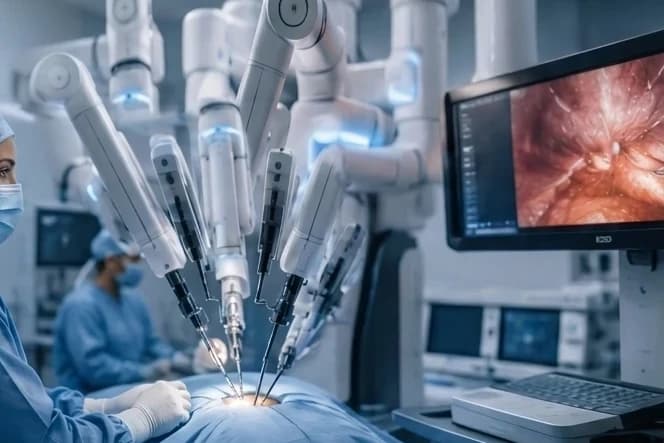
What is robotic-assisted surgery, actually?
Despite the name, the robot doesn't operate on its own -- your surgeon controls every instrument movement in real time from a console in the same room, the whole time. The system translates the surgeon's hand movements into smaller, steadier motions of tiny instruments inside the body, viewed through a magnified 3D camera. It's more accurate to think of it as an advanced set of tools the surgeon operates directly, not an autonomous machine making decisions.
How is it different from open or standard laparoscopic surgery?
Open surgery uses one larger incision and the surgeon's hands directly. Standard laparoscopic surgery uses several small incisions and long rigid instruments, viewed on a 2D screen. Robotic-assisted surgery also uses several small incisions, but the instruments have a wider range of motion -- closer to how a wrist moves -- and the surgeon views the surgical field in 3D and magnified. Whether this translates into a meaningful difference for a specific patient depends on the procedure and the individual case, which is exactly what a surgeon consultation is for.
What is it genuinely used for here?
Fibroids
Myomectomy & hysterectomy
Endometriosis
Excision surgery
Complex cases
Advanced hysterectomy
Who is it genuinely appropriate for?
Not every patient or every case is a good candidate for a robotic-assisted approach -- this depends on the specific condition, its extent, your surgical history, and your overall health. Your surgeon evaluates this individually and will discuss whether an open, standard laparoscopic, or robotic-assisted approach genuinely fits your situation, rather than defaulting to one option.
When might it not be the best choice?
Sometimes another approach may be just as appropriate, or more appropriate, for your specific case -- because of your anatomy, the extent of the disease, prior surgery, an urgent situation, limited local availability of the technology, or your surgeon's own experience and judgment. The best operation is not necessarily the most technologically advanced operation -- it's the one genuinely suited to your situation, which is a decision your surgeon makes together with you, not one CARENYX makes for you.
How does a patient actually get to robotic surgery?
Broadly: diagnosis is confirmed, treatment options are discussed, your suitability for each approach is assessed, alternatives are explained, your surgeon makes a recommendation, and you give informed consent before anything proceeds. You are never "selected" for robotic surgery by an algorithm or by CARENYX -- this decision belongs to you and your treating surgical team, based on your specific case.
What can genuinely be better, for eligible patients
- • Typically a shorter hospital stay than open surgery
- • Typically a faster return to normal daily activity
- • Typically less visible scarring, from smaller incisions
- • Typically less blood loss during the procedure
These are typical patterns seen across many patients, not a guarantee for any individual case -- your surgeon can discuss what's realistic for your specific situation.
Real risks, honestly
Like any surgery, robotic-assisted procedures carry real risks -- anaesthesia risks, bleeding, infection, injury to nearby organs, blood clots, and the possibility of needing to convert to an open procedure if something unexpected is found during surgery. Robotic-assisted surgery is not risk-free, and it is not automatically the right or safer choice for every patient -- your surgeon will explain the specific risks relevant to your procedure and health history before you consent to anything.
The risks of surgery depend much more on the specific operation and your individual health than on the word "robotic" alone -- it's not a separate risk category, just a different way of performing many of the same operations.
What actually happens, step by step?
Before surgery
Consultation, confirming the diagnosis, relevant investigations, a medical and anaesthesia assessment, a discussion of alternatives, a review of your current medicines, informed consent, and practical preparation instructions from your surgical team.
During surgery
You receive anaesthesia and are positioned for the operation. Small access points are made for the camera and instruments. Your surgeon views the surgical field through the magnified camera and controls every instrument movement from the console, throughout, with a full surgical team present and monitoring you the entire time.
After surgery
Recovery monitoring, pain management, gradual mobilisation, guidance on diet and wound care, a discharge plan, and follow-up appointments. Recovery differs substantially by procedure -- your surgical team will give you a realistic timeline for your specific operation rather than a generic one.
How should I think about my decision?
A simple framework to work through with your surgeon, not a substitute for that conversation:
- 1. Understand the problem. What operation is actually being proposed, and why?
- 2. Understand the alternatives. Could this be done open, laparoscopically, or another way?
- 3. Understand why robotic assistance is being recommended. What specific benefit is expected in your operation?
- 4. Understand the risks. What are the risks of this specific procedure, for you?
- 5. Understand your surgeon's experience. Who will perform it, and how experienced are they with it?
- 6. Understand recovery and cost. What should you realistically expect afterward, and what will it cost?
Questions worth asking your surgeon
- Why are you recommending robotic surgery for me specifically?
- What alternatives do I have, and what would you recommend if robotic surgery weren't available?
- What benefit do you expect specifically in my operation?
- What are the important risks for my procedure and health history?
- How many robotic-assisted procedures of this specific type have you personally performed?
- What happens if the operation needs to change to another approach during surgery?
- What will recovery involve, and what should I expect in the first few days and weeks?
- What will this cost, and what may my insurance cover?
Robotic surgery in women's health
Robotic assistance may be considered, for selected patients and selected procedures, for gynaecological surgery such as hysterectomy, fibroid-related surgery, and some endometriosis or complex pelvic procedures. This does not mean every fibroid case or every hysterectomy should be robotic, or that a robotic-assisted approach is automatically superior -- your gynaecologic surgeon will discuss whether it's genuinely appropriate for your specific case, exactly as with any other operation.
Other surgical specialties (tap to expand)
Robotic-assisted techniques exist across several surgical specialties beyond gynaecology, such as urology and general surgery. This Centre focuses on the gynaecological procedures genuinely covered by CARENYX's current clinical scope, described above -- it does not represent or imply that CARENYX offers robotic surgery in other specialties. If you're considering robotic surgery for a different condition, the general principles on this page (robot vs. surgeon, alternatives, risks, decision framework) still apply, but ask your own treating surgeon for specialty-specific detail.
What affects the cost? (tap to expand)
We don't publish prices here, because cost depends on several factors specific to your case:
- The specific procedure and its complexity
- The hospital and the robotic platform used
- Length of hospital stay
- Pre-operative investigations and anaesthesia
- Consumables and equipment used during surgery
- Your insurance policy and its specific terms
Insurance coverage for robotic-assisted procedures varies significantly by insurer and policy -- confirm directly with your insurer and hospital before proceeding, rather than assuming coverage.
Frequently asked questions (tap to expand)
Is the robot doing the surgery?
No. Your surgeon controls every instrument movement in real time, the entire procedure.
Does robotic surgery mean the surgeon is less involved?
No -- if anything, the surgeon is continuously, directly controlling the instruments rather than stepping back.
Is robotic surgery safer?
Not universally. Safety depends much more on the specific procedure, your health, and your surgeon's experience than on the word "robotic" alone.
Is robotic surgery always better?
No. It's genuinely appropriate for many, but not all, cases and patients.
Will robotic surgery cause less pain?
Many patients report less pain than after open surgery, but this isn't guaranteed and varies by procedure and person.
Will I recover faster?
Often yes for eligible patients compared with open surgery, but recovery still varies by procedure and individual.
Is robotic surgery suitable for everyone?
No. Suitability depends on your specific condition, anatomy, and surgical history.
Is robotic surgery more expensive?
It can involve higher technology and hospital costs than some other approaches -- confirm specifics with your hospital and insurer.
Can the surgeon change to another approach during surgery?
Yes -- if something unexpected is found, converting to an open or laparoscopic approach may be the safest choice, and your surgeon will explain this possibility beforehand.
What happens if the robotic system can't be used?
Your surgical team has a plan for this; it may mean switching to another surgical approach during the same operation.
Does the surgeon need special training?
Yes -- robotic-assisted surgery requires specific training and experience beyond general surgical training.
How do I know whether robotic surgery is appropriate for me?
This is determined by your surgeon based on your specific diagnosis, anatomy, and health -- not something to conclude on your own from this page.
Common myths
"The robot performs the surgery on its own."
Your surgeon controls every movement, in real time, the entire procedure. The system has no autonomous decision-making role.
"Robotic surgery means no surgeon is needed."
A specially trained surgeon is required throughout, continuously controlling the instruments.
"Robotic-assisted is always the safest, best option."
It's genuinely appropriate for many, not all, cases -- the right approach depends on your specific condition and surgical history.
"Robotic surgery means no scars."
It typically means smaller scars from smaller incisions, not the complete absence of scarring.
"Robotic surgery means no pain."
It can mean less pain than open surgery for many patients, but it doesn't eliminate post-surgical pain.
"Robotic surgery guarantees faster recovery."
Faster recovery is a common pattern for eligible patients, not a guarantee for every individual.
"If robotic surgery is available, I should choose it."
Availability doesn't make it the right choice for your specific case -- that's a decision for you and your surgeon together.
Want to understand endometriosis itself before considering surgery? Read the real, clinician-reviewed article in the Health Library.
Request a ConsultationAlso on CARENYX: Spine Recovery Hub · CARENYX Nutrition+