Executive Summary
Your menstrual cycle is a monthly hormonal process, not just "your period" — the bleeding itself is only one part of a cycle that also includes ovulation and significant hormonal changes throughout the month. A useful way to think about it: a normal, regular cycle is a genuine sign of overall hormonal health, which is exactly why major medical bodies now recommend treating it as a "vital sign" worth paying attention to, not an inconvenience to ignore.
"Normal" covers a genuinely wide range — cycle length, flow, and symptoms vary considerably between individuals and even from cycle to cycle in the same person. This article explains what's actually happening hormonally each month, what the real range of normal looks like, and when a change in your cycle is worth mentioning to a doctor rather than assuming it will sort itself out.
Red Flags
⚠ Seek prompt medical care if you have:
- Bleeding heavy enough to soak through a pad or tampon every hour for several consecutive hours
- Bleeding with dizziness, lightheadedness, or fainting
- Severe pain that's substantially different from or worse than your usual pattern
- No period for more than 3 months without a clear explanation (such as pregnancy) — take a pregnancy test first
- Fainting with bleeding, or severe one-sided pain with a late period: go to emergency (possible ectopic pregnancy)
- Any bleeding after menopause, or bleeding after sex: see a gynaecologist promptly
These can indicate significant blood loss, an underlying condition needing evaluation, or, rarely, pregnancy-related complications — all worth prompt attention rather than waiting to see if they resolve.
Read the full article15 min · causes, tests, treatment, exercises, questions
Introduction
Many women learn the basics of their menstrual cycle once, briefly, as teenagers, and never revisit it — which means a lot of the specific, useful detail either was never explained clearly or has simply been forgotten by the time it would actually be useful, whether you're trying to understand your own body better, trying to conceive, or trying to figure out whether something you're experiencing is normal.
This article is written to be that clear explanation, for any age and any reason you're reading it — covering the real hormonal process, the genuine range of what's normal, and when it's worth raising a change with your doctor.
The Menstrual Cycle's Four Phases
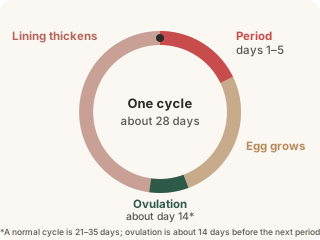
Your cycle is counted from the first day of one period to the first day of the next, and a typical cycle involves four overlapping phases, driven by a coordinated hormonal conversation between your brain and ovaries (the same hypothalamic-pituitary-ovarian axis introduced in Carenyx's PCOS article):
- Menstrual phase (roughly days 1-5, though this varies): your period — the shedding of the uterine lining built up during the previous cycle, if pregnancy didn't occur.
- Follicular phase (roughly days 1-13, overlapping with your period): your brain releases follicle-stimulating hormone (FSH), prompting several follicles in your ovaries to begin developing. Estrogen levels gradually rise as one follicle typically becomes dominant.
- Ovulation (typically around day 14 in a 28-day cycle, though this varies significantly between individuals and cycles): a surge in luteinizing hormone (LH) triggers the release of a mature egg from the dominant follicle.
- Luteal phase (roughly days 15-28): the follicle that released the egg transforms into a temporary hormone-producing structure called the corpus luteum, producing progesterone to prepare your uterine lining for a possible pregnancy. If pregnancy doesn't occur, progesterone and estrogen levels fall, the corpus luteum breaks down, and the uterine lining sheds — starting your next period, and the cycle again.
Physical Signs That Change Across Your Cycle
Beyond the bleeding itself, several physical signs shift predictably across the cycle, reflecting the same underlying hormonal changes — genuinely useful to know, whether out of general body literacy or because you're specifically trying to understand your fertile window:
- Cervical mucus typically changes from minimal or absent just after your period, to a clearer, slippery, stretchy consistency (often compared to raw egg white) around the time of ovulation as estrogen rises, then to a thicker, less noticeable consistency during the luteal phase under progesterone's influence.
- Basal body temperature (your body's resting temperature, measured first thing in the morning) typically rises slightly — by a small but measurable amount — after ovulation, due to progesterone's effect, and stays elevated through the luteal phase until your next period.
- Breast tenderness is common in the days leading up to a period for many people, related to the hormonal changes of the luteal phase, and typically eases once the period starts.
These signs form the basis of fertility awareness methods. They are useful here simply as further evidence of how much genuine, predictable physiological change happens across a normal cycle, beyond the bleeding most people focus on.
What Counts as Normal: The Real Range
One of the most useful things to know about your cycle is how wide the real range of "normal" actually is, based on large studies of real menstrual data.
- Cycle length: a cycle of 21 to 35 days is generally considered within the normal range for adults, with some natural variation from cycle to cycle even in the same person being entirely typical.
- Period (bleeding) duration: typically 2 to 7 days.
- Ovulation timing: while often described as "day 14," ovulation timing actually varies considerably between individuals and even between cycles in the same person, and doesn't always fall precisely in the middle of the cycle.
- Flow volume: genuinely variable between individuals, without one universally agreed "normal" volume — though a consistent, significant change in your own typical flow is more relevant than comparing your flow to anyone else's.
- Cycle-to-cycle variation: some month-to-month variability in your own cycle length is normal and expected, not necessarily a sign of a problem — significant, persistent irregularity (as discussed in Carenyx's PCOS article) is a different matter from ordinary variation.
Adolescents in the first few years after their first period, and women approaching perimenopause, commonly have wider cycle variability as a normal part of those specific life stages — discussed further in the "How Your Cycle Changes" section below.
When Your Cycle Might Signal a Problem
Most cycle variation is entirely normal, but certain patterns are worth paying attention to and discussing with a doctor:
- Cycles consistently shorter than 21 days or longer than 35 days.
- Periods lasting longer than 7 days, or a significant, persistent change in your usual duration.
- No period for 3 months or more, without pregnancy or breastfeeding as the explanation (take a pregnancy test first).
- No period by age 15, any gap of more than 90 days, or bleeding longer than 7 days: see a doctor.
- Bleeding between periods, outside of your expected menstrual flow.
- Pain significantly beyond typical period discomfort — covered in more detail in Carenyx's article on endometriosis.
- Very heavy bleeding: soaking through a pad or tampon every hour for several consecutive hours, or passing clots larger than a coin.
None of these automatically mean something serious is wrong — many have straightforward, manageable explanations — but they're the specific signal that a conversation with a doctor, rather than assuming it will resolve on its own, is the right next step.
Tracking Your Cycle: What to Record and Why
Tracking a few simple things each cycle — whether on paper, in an app, or in Carenyx's own dashboard — makes it dramatically easier to describe a genuine change accurately to a doctor, rather than relying on memory alone:
- The first day of each period — the single most useful data point, since it's what cycle length is actually calculated from.
- Approximate flow (light, moderate, heavy) each day of your period.
- Any pain, and roughly how it compares to your usual pattern.
- Other symptoms you notice with any regularity — mood changes, breast tenderness, headaches — since real patterns across several cycles are far more useful to a doctor than a single cycle's description.
Three to six months of this kind of simple tracking is often enough to answer the exact question "has this actually changed, or does it just feel different this month" — a genuinely useful distinction most people can't reliably make from memory alone.
Managing Common Cycle-Related Discomfort
- Mild to moderate period pain often responds well to standard anti-inflammatory pain relief (NSAIDs), taken as directed and on a doctor's or pharmacist's advice (avoid if you have ulcers, asthma triggered by painkillers, kidney disease or are pregnant), ideally starting just before or at the onset of pain rather than waiting until it's severe.
- A heating pad or hot water bottle on the lower abdomen is a simple, low-risk measure many people find genuinely helpful for cramping.
- Regular physical activity across your cycle, not only avoiding it during your period, is associated with reduced period-related discomfort for many people.
- Premenstrual mood and physical symptoms (commonly grouped as PMS) are real and can be significant for some people — if they're substantially affecting your daily life, that's worth raising with a doctor directly, since real treatment options exist beyond "just getting through it."
Pain significant enough that standard measures don't adequately help, or that regularly interferes with your daily activities, is exactly the kind of pattern discussed in Carenyx's endometriosis article — worth a real evaluation, not an escalating home-remedy search.
Lifestyle and Your Cycle
Several real, evidence-based lifestyle factors can influence cycle regularity:
- Significant weight changes (either direction) can affect cycle regularity, related to the hormonal role that body fat plays in the broader hormonal system.
- High stress levels can genuinely affect cycle timing for some people, through the same brain-hormone pathways that regulate the cycle overall.
- Significant changes in exercise intensity, particularly very high training loads without adequate nutrition, can affect cycle regularity, well-documented in athletic populations.
- Sleep disruption and shift work have some evidence linking them to cycle irregularity, an active area of ongoing research.
None of this means minor life stress or a normal exercise routine will disrupt your cycle — these are associations relevant at a more significant, sustained level, not a reason to worry about ordinary daily life.
How Your Cycle Changes Across Your Life
- The first 1-2 years after your first period commonly involve irregular cycles as your hormonal system establishes its regular pattern — a normal part of adolescence, not usually a cause for concern on its own.
- Your 20s and 30s typically bring the most regular cycle pattern for most people, though "regular" still allows for the natural variation described earlier in this article.
- Perimenopause (the years leading up to menopause, often starting in the 40s) commonly brings a return to more cycle irregularity, as ovarian hormone production naturally becomes less consistent.
- Pregnancy and breastfeeding pause your cycle entirely for a period, which is expected and not itself a concern.
If You're Using Hormonal Contraception
Everything described in this article is about your natural, unmedicated cycle. If you use hormonal contraception — combined pills, a hormonal IUD, an implant, or an injection — the bleeding pattern you experience is influenced or, in some cases, largely created by that medication, not solely by your natural hormonal cycle underneath it. This is genuinely worth understanding clearly:
- The "monthly bleed" many combined contraceptive pill regimens produce is a withdrawal bleed — a response to a scheduled pause in hormone dosing, not a true menstrual period reflecting ovulation, since combined methods, implants and injections usually stop ovulation, while hormonal IUDs often do not.
- Some hormonal methods, particularly certain IUDs and implants, commonly cause much lighter bleeding, irregular spotting, or no bleeding at all — genuinely normal and expected effects of those specific methods, not necessarily a sign that something is wrong.
- If you stop hormonal contraception, it can take a few cycles for your natural pattern to re-establish itself, and what re-emerges may look somewhat different from your pattern before you started, without that necessarily indicating a problem. Fertility can take up to a year to return after the injection.
Supporting a Healthy Cycle
- Maintain a generally healthy body weight, recognizing this looks different for every individual, since both significantly low and high body weight can affect cycle regularity.
- Manage stress where possible, through whatever genuinely works for you — exercise, sleep, or other approaches.
- Prioritize consistent sleep.
- Track your cycle even when everything feels normal, since it's far easier to notice a genuine change against an existing record than from memory alone.
- Don't dismiss a real, sustained change in your usual pattern as "probably nothing" without at least mentioning it at your next routine visit.
Frequently Asked Questions
Is a 28-day cycle the only "normal" cycle length? No — this is one of the most common misconceptions about the menstrual cycle. Cycles between 21 and 35 days are all considered within the normal range, and some natural month-to-month variation is expected.
Can I get pregnant during my period? It's less likely than during your fertile window, but not impossible, particularly with a shorter cycle where ovulation could occur relatively soon after your period ends and sperm can survive for several days.
Why does my cycle length vary slightly from month to month? Some cycle-to-cycle variation is entirely normal, reflecting the natural variability of the hormonal process rather than a problem. Persistent, significant irregularity is different from this ordinary variation.
Is it normal to skip a period occasionally? An occasional skipped or delayed period, particularly around significant stress, illness, or travel, isn't unusual. A pattern of regularly skipped periods, or no period for 3 months or more, is the threshold worth discussing with a doctor.
Do I need to see a doctor if my periods are just mildly irregular? Not necessarily — mild variation within the normal range described in this article usually doesn't need evaluation. Significant, persistent irregularity, or irregularity combined with other symptoms (such as those discussed in Carenyx's PCOS article), is what warrants a proper evaluation.
Does the menstrual cycle affect anything besides fertility? Yes — the hormonal changes across your cycle can genuinely affect mood, energy, skin, and sleep for many people, which is part of why treating the cycle as a meaningful "vital sign" rather than only a fertility marker has become standard medical guidance.
If I'm on the birth control pill, is my "period" a real period? Not quite — it's a withdrawal bleed, a response to a scheduled pause in your pill's hormone dosing, since the pill typically suppresses ovulation and your natural cycle underneath it. It's a genuinely different process from the natural period described in the rest of this article, though the visible bleeding can look similar.
How long should I track my cycle before I can tell if something's actually changed? Three to six cycles of simple tracking is usually enough to distinguish a real, sustained change from normal month-to-month variation. A single unusual cycle is rarely enough information on its own to draw a firm conclusion either way.
Myths vs. Facts
Myth: Every normal cycle is exactly 28 days. Fact: 28 days is simply the commonly cited average — the real normal range is 21 to 35 days, with natural month-to-month variation.
Myth: You shouldn't exercise, swim, or wash your hair during your period. Fact: None of these have any real medical basis. Exercise during your period is safe and, for many people, genuinely helps with cramping and mood.
Myth: Period blood is somehow "dirty" or represents accumulated toxins. Fact: Menstrual blood is simply the shed uterine lining and blood — a normal bodily process, not a mechanism for removing toxins from anywhere else in the body.
Myth: Ovulation always happens exactly on day 14. Fact: Ovulation timing varies meaningfully between individuals and cycles, and doesn't always fall precisely mid-cycle, particularly in cycles longer or shorter than 28 days.
Myth: Irregular periods are just "how some women's bodies are" and don't need checking. Fact: While mild variation is normal, persistent significant irregularity often has an identifiable, treatable underlying cause — including conditions like PCOS discussed elsewhere in this library — and is worth a real evaluation rather than being accepted as unexplainable.
Glossary
- Basal body temperature: the body's resting temperature, measured first thing in the morning, which rises slightly after ovulation due to progesterone's effect.
- Breast tenderness: soreness or sensitivity in the breasts, common in the days leading up to a period as a normal effect of luteal-phase hormonal changes.
- Cervical mucus: fluid produced by the cervix that changes in consistency across the cycle, becoming clearer and more slippery around ovulation.
- Corpus luteum: a temporary hormone-producing structure that forms from the follicle after ovulation, producing progesterone.
- Follicle-stimulating hormone (FSH): a hormone released by the brain that stimulates follicle development in the ovaries.
- Follicular phase: the first part of the menstrual cycle, during which follicles develop in the ovaries.
- Hypothalamic-pituitary-ovarian (HPO) axis: the hormonal communication system between the brain and ovaries that regulates the menstrual cycle.
- Luteal phase: the second half of the menstrual cycle, after ovulation, when progesterone prepares the uterine lining for a possible pregnancy.
- Luteinizing hormone (LH): a hormone released by the brain that triggers ovulation.
- Menstrual phase: the period of bleeding, marking the shedding of the uterine lining.
- Ovulation: the release of a mature egg from the ovary.
- Perimenopause: the years leading up to menopause, during which hormone levels and cycle regularity naturally begin to change.
- Withdrawal bleed: the bleeding pattern produced by a scheduled pause in hormone dosing during combined hormonal contraceptive use — distinct from a natural menstrual period, since ovulation is typically suppressed throughout.
References (Vancouver Style)
Reference list reviewed November 2026. Each source links to its PubMed record, the guideline's official page, or a PubMed search for the exact title.
- American College of Obstetricians and Gynecologists. Committee Opinion No. 651: Menstruation in girls and adolescents: using the menstrual cycle as a vital sign. Obstet Gynecol. 2015;126(6):e143-e146. Link Link
- Bull JR, Rowland SP, Scherwitzl EB, et al. Real-world menstrual cycle characteristics of more than 600,000 menstrual cycles. NPJ Digit Med. 2019;2:83. Link Link
- Direito A, Bailly S, Mariani A, Ecochard R. Relationships between the luteinizing hormone surge and other characteristics of the menstrual cycle in normally ovulating women. Fertil Steril. 2013;99(1):279-285. Link Link
- Munro MG, Critchley HOD, Fraser IS; FIGO Menstrual Disorders Committee. The two FIGO systems for normal and abnormal uterine bleeding symptoms and classification of causes of abnormal uterine bleeding in the reproductive years. Int J Gynaecol Obstet. 2018;143(3):393-408. Link Link
- Reed BG, Carr BR. The Normal Menstrual Cycle and the Control of Ovulation. In: Endotext. South Dartmouth (MA): MDText.com; 2018. Link Link
Related Articles
- Understanding PCOS: Causes, Symptoms, Diagnosis and Long-Term Management
- Endometriosis: Why Diagnosis Takes So Long, and What Helps
Call to Action
Understanding your own baseline is the real foundation for noticing when something genuinely changes.
Track your cycle with the Carenyx Patient Portal → — see your own cycle data reflected back in a way that makes patterns easier to notice.
Have a question about your own cycle? Request a consultation with Dr. Neha Gupta →