Executive Summary
Cervical myelopathy is compression of the spinal cord itself, in the neck — a more serious condition than cervical radiculopathy (nerve root compression), which is covered in CARENYX's dedicated Cervical Disc Disease article. The most common form, cervical spondylotic myelopathy, develops from age-related degenerative changes and is genuinely the most common cause of spinal cord dysfunction in adults, especially over 55. A related cause, ossification of the posterior longitudinal ligament (OPLL), is relatively more common in Asian populations.
Here is what the evidence actually shows: unlike ordinary neck pain, cervical myelopathy typically doesn't improve on its own, and real, current clinical guidelines identify surgery as the definitive treatment once meaningful symptoms are present, since the natural course is gradual, stepwise worsening rather than spontaneous recovery. This article explains what cervical myelopathy actually is, its real, distinctive symptoms, how doctors diagnose and grade it, and what treatment actually involves.
Red Flags: When This Is a Medical Emergency
⚠ See a doctor immediately if you have:
- Rapidly worsening hand weakness or gait instability
- New loss of bladder or bowel control
- A sudden, significant decline in symptoms rather than the more typical slow, stepwise pattern
While cervical myelopathy usually progresses gradually, a rapid decline can indicate acute worsening that needs urgent evaluation.
Read the full article6 min · causes, tests, treatment, exercises, questions
Introduction
The spinal cord runs through a protected canal in your neck, carrying nerve signals between your brain and the rest of your body. When age-related changes — bone spurs, thickened ligaments, disc bulges — narrow this canal enough to compress the cord itself, the result is cervical myelopathy. This is genuinely different from cervical radiculopathy, where a single nerve root (not the cord itself) is compressed, causing arm symptoms rather than the broader, whole-body pattern myelopathy produces.
How Cervical Myelopathy Develops
Real, current understanding identifies cervical spondylotic myelopathy — the age-related form — as the most common type, developing from the same degenerative changes described in CARENYX's Cervical Disc Disease and Degenerative Disc Disease articles, but severe enough at one or more levels to compress the cord itself rather than only a nerve root or disc space. It typically occurs in patients over 40, though people born with a naturally narrower spinal canal can develop it earlier.
Symptoms: What Cervical Myelopathy Actually Feels Like
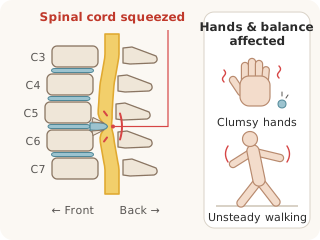
Real, distinctive symptoms of cervical myelopathy include:
- Numbness or clumsiness in the hands — difficulty with fine tasks like buttoning a shirt or handling small objects
- Gait and balance problems — an unsteady walk, without the spinning sensation of true vertigo
- Weakness in the arms or legs
- Neck pain or stiffness, though this is often less prominent than the hand and gait symptoms
- In more advanced cases, bladder or bowel changes
A real, important diagnostic pattern: the combination of hand clumsiness and gait instability, without vertigo, is a genuinely distinctive real signal that points toward myelopathy rather than an inner-ear or general balance problem.
Diagnosis: How Doctors Confirm Cervical Myelopathy
Diagnosis combines a real, specific physical exam with imaging. Real, specific exam findings doctors look for include the Hoffman sign, a hyperactive pectoralis reflex, an inverted radial reflex, and the "finger escape sign" (difficulty holding the fingers together in extension) — each a real, named clinical test with established diagnostic value.
MRI is the real, standard imaging test of choice, directly visualizing cord compression and any signal change within the cord itself — a more serious finding than the disc-level changes seen in ordinary cervical disc disease. Doctors also use the modified Japanese Orthopaedic Association (mJOA) score, a real, standardized scale, to grade severity: mild (15–17), moderate (12–14), or severe (11 or below) — this real, numeric grading directly guides treatment decisions.
Your doctor may also check vitamin B12, since deficiency — common in India — can cause very similar symptoms; MS and motor neurone disease are other look-alikes.
Treatment Options
Real, current clinical practice guidelines distinguish treatment by severity.:
- Mild myelopathy (mJOA 15–17) without clear gait or hand-function impairment: conservative management with close monitoring may be considered, since real evidence here is less definitive than for surgery in more advanced cases.
- Moderate to severe myelopathy, or any evidence of progression: surgery is the real, standard, evidence-supported recommendation, since the natural history of untreated myelopathy is gradual, stepwise decline rather than improvement.
Real surgical approaches include anterior decompression (often with discectomy or corpectomy and fusion) and posterior approaches (laminectomy with fusion, or laminoplasty, which preserves motion). Real, published comparisons show anterior and posterior approaches achieve broadly similar neurological recovery, with the specific choice depending on the number of levels involved, the direction of compression, and your individual anatomy.
Exercises
Given cervical myelopathy is a structural, cord-compression condition, real, current guidance is that exercise does not treat the underlying compression, and any exercise program should be guided directly by your surgeon, particularly avoiding high-impact activity or extremes of neck motion before treatment. Avoid neck manipulation or 'cracking', heavy overhead lifting and activities with a high fall risk. A fall or whiplash with an already narrowed canal can cause sudden paralysis — seek emergency care after any neck injury. After appropriate surgical treatment, real, standard post-operative rehabilitation follows the same general principles described in CARENYX's Cervical Disc Disease article.
Recovery Timeline
Real, published outcomes show most patients experience meaningful neurological improvement after appropriately timed surgery, though recovery is often gradual over months, and some residual symptoms — particularly if surgery was delayed until advanced compression had already caused lasting cord change — can persist. This is one real, important reason earlier diagnosis and treatment generally produce better outcomes than waiting.
Frequently Asked Questions
Is cervical myelopathy the same as a pinched nerve? No — a pinched nerve (cervical radiculopathy) affects a single nerve root, causing arm symptoms. Myelopathy affects the spinal cord itself, causing a broader pattern involving both hands, gait, and balance.
Can cervical myelopathy get better without surgery? For mild cases, real, current guidance allows for careful conservative monitoring, but for moderate to severe cases, real evidence supports surgery as the standard, most effective treatment, since spontaneous improvement is uncommon.
Is surgery for cervical myelopathy risky? Like any spine surgery it carries real, individual risks your surgeon will discuss directly, but real, published evidence supports it as an effective, well-established treatment for appropriately selected patients.
Glossary
- Cervical spondylotic myelopathy — the most common, age-related form of cervical myelopathy.
- mJOA score — modified Japanese Orthopaedic Association score, used to grade myelopathy severity.
- Laminoplasty — a motion-preserving posterior surgical technique for decompressing the spinal cord.
- Hoffman sign — a real, specific physical exam test for myelopathy.
References (Vancouver Style)
Reference list reviewed November 2026. Each source links to its PubMed record, the guideline's official page, or a PubMed search for the exact title.
- Fehlings MG, Tetreault LA, Riew KD, et al. A clinical practice guideline for the management of patients with degenerative cervical myelopathy. Global Spine J. 2017;7(3 Suppl):70S-83S. Link
- Davies BM, Mowforth OD, Smith EK, Kotter MR. Degenerative cervical myelopathy. BMJ. 2018;360:k186. Link
- Ghogawala Z, Terrin N, Dunbar MR, et al. Effect of ventral vs dorsal spinal surgery on patient-reported physical functioning in patients with cervical spondylotic myelopathy: a randomized clinical trial. JAMA. 2021;325(10):942-951. Link
- Rhee JM, Shamji MF, Erwin WM, et al. Nonoperative management of cervical myelopathy: a systematic review. Spine. 2013;38(22 Suppl 1):S55-S67. Link
Call to Action
If you're noticing hand clumsiness, an unsteady walk, or other symptoms described above, book a real consultation with CARENYX's spine team for prompt evaluation — earlier diagnosis generally means better outcomes with this specific condition.