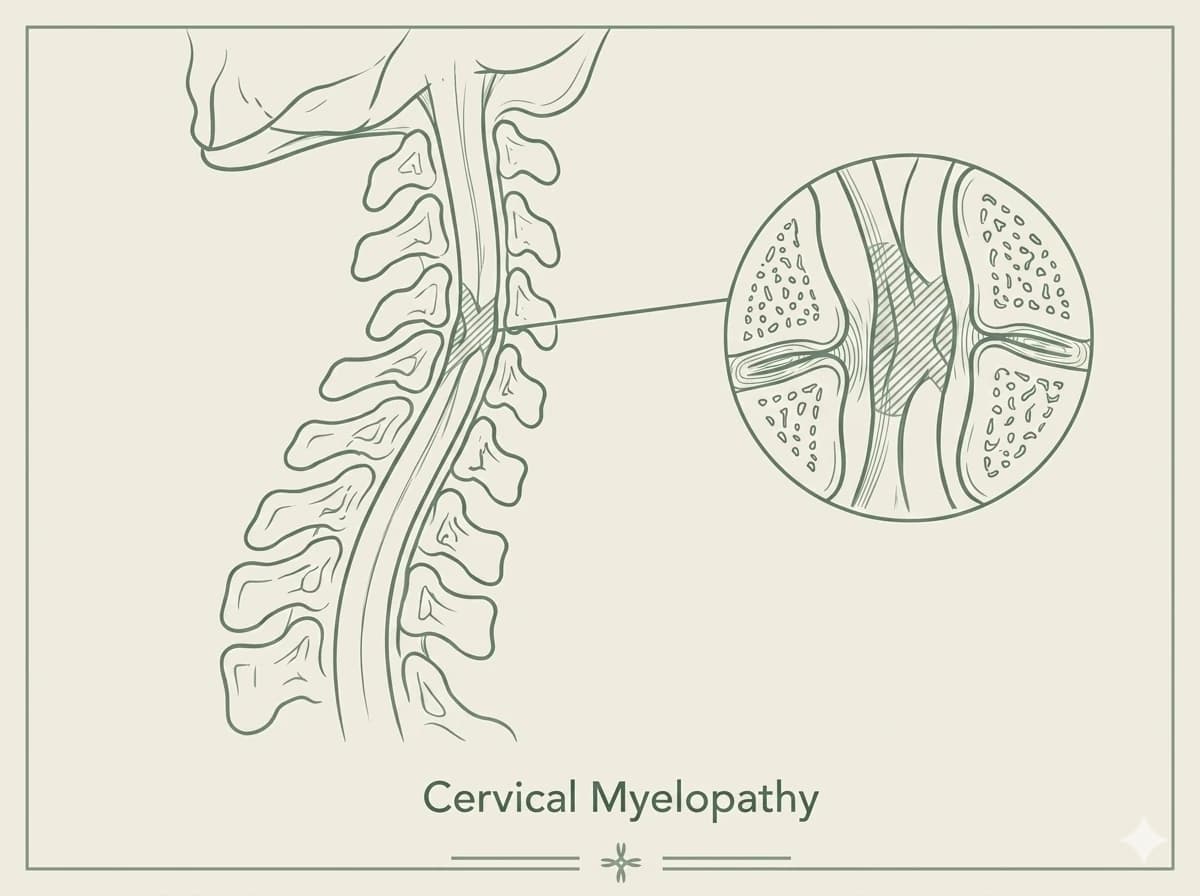
Cervical Myelopathy
Understand spinal cord compression, recognise the warning signs early and learn how modern spine surgery can prevent permanent disability.
This page provides educational information and is not a substitute for consultation with a qualified spine surgeon. It does not replace your own doctor's evaluation of your specific symptoms and MRI findings.
What Is Cervical Myelopathy?
What Is the Spinal Cord?
Your spinal cord is the thick, real bundle of nerve tissue running from your brain, down through the protective bony tunnel in your spine, carrying every signal between your brain and the rest of your body — every movement you make, and every sensation you feel, travels through it.
Think of it as the body's main highway for nerve signals. A road with a few lanes closed still lets some traffic through, but slowly, and with real, growing disruption — this is genuinely similar to what happens when your spinal cord is compressed.

How Is the Spinal Cord Different from Nerves?
Individual nerves — like the ones that branch out from your spine into your arms — carry signals to and from one specific, real part of your body. The spinal cord itself is different: it's the real, central trunk line all of those individual nerves ultimately connect back to.
This is exactly why compressing the spinal cord is genuinely more serious than compressing a single nerve — a single compressed nerve (like in an ordinary slip disc) typically affects one arm or leg; compressing the spinal cord itself can affect both hands, both legs, balance, and more, all at once.
What Is Spinal Cord Compression?
Spinal cord compression means something — most commonly age-related bone and ligament changes in your neck — is pressing on this real, central nerve highway, narrowing the space it needs and disrupting the signals traveling through it.
This is the real, medical definition of cervical myelopathy: cervical means "in the neck," and myelopathy means "spinal cord disease." Put simply, cervical myelopathy is spinal cord compression happening in your neck.
Why Does Compression Damage Walking and Hand Function?
The specific nerve pathways controlling fine hand movements and coordinated walking are genuinely concentrated within the spinal cord in ways that make them particularly sensitive to compression — this is a real, specific reason hand clumsiness and gait changes are often the earliest, most noticeable real signs of this condition, even before pain becomes prominent.
Here is the single most important real fact on this entire page: this damage, while serious, is genuinely preventable with timely treatment. Compression that's relieved before lasting cord damage occurs allows real, meaningful recovery — this is exactly why recognizing the early warning signs covered below, and acting on them promptly, matters so much.
Neck Pain vs. Cervical Radiculopathy vs. Cervical Disc Herniation vs. Cervical Myelopathy
These four real, related but genuinely distinct conditions are often confused. Ordinary neck pain stays localized to the neck itself, with no arm or hand symptoms — the large majority of neck pain fits this real, non-serious pattern, covered in complete detail in CARENYX's Neck Pain Knowledge Centre.
Cervical radiculopathy and cervical disc herniation both describe a single nerve root being compressed (a herniated disc is the real, most common cause of radiculopathy) — causing pain, numbness, or weakness following a specific path down one arm, covered in complete detail in CARENYX's Cervical Slip Disc Knowledge Centre.
Cervical myelopathy is genuinely different and more serious: the spinal cord itself, not just one nerve root, is compressed — producing a broader real pattern affecting hand coordination, walking, and balance, sometimes on both sides of the body at once, rather than one arm alone. This is the real, specific focus of this page.
Why Does It Occur?
Age-Related Degeneration
Age is the real, single most common underlying cause — cervical spondylotic myelopathy, the age-related form, genuinely is the most frequent cause of spinal cord dysfunction in adults over 40, developing gradually as several real, normal aging changes accumulate together over years.
Disc Prolapse
A significant disc herniation, covered in complete detail in CARENYX's Cervical Slip Disc Knowledge Centre, can — in more severe cases — press on the spinal cord itself rather than only a nerve root, contributing to myelopathy.
Bone Spurs
Osteophytes (bone spurs) forming as the body's real, natural response to joint wear can genuinely encroach on the space the spinal cord needs, particularly when they develop at the back of the vertebral bodies, directly facing the cord.
Spinal Stenosis
Cervical spinal stenosis — narrowing of the protective canal around the spinal cord — is a real, closely related condition, covered in complete detail in CARENYX's Spinal Stenosis Knowledge Centre; when this narrowing becomes significant enough in the neck specifically, myelopathy is the real, direct result.
Ligament Thickening
The ligamentum flavum, a real, specific ligament running along the back of the spinal canal, can thicken with age, genuinely narrowing the available space for the spinal cord — one of the most significant, common contributors to this condition.
OPLL (Ossification of the Posterior Longitudinal Ligament)
OPLL is a real, specific condition where a ligament running along the front of the spinal canal gradually turns to bone, directly narrowing the space available for the spinal cord — genuinely more common in some populations than others, and an important, real cause your surgeon specifically checks for on imaging.
Trauma
A significant fall, accident, or whiplash-type injury can directly injure or compress the spinal cord, sometimes triggering sudden, severe symptoms in a spine already somewhat narrowed by age-related change — this specific scenario is a real, genuine emergency, covered in the Red Flag Warning section below.
Tumours
A genuinely rare cause — a tumor within or near the spinal canal can directly compress the cord. Real, current guidance flags this specific possibility particularly with a personal cancer history or unexplained weight loss.
Infections
Spinal infections are a genuinely rare but real and serious cause of cord compression through inflammation and tissue swelling, particularly relevant with real risk factors like fever, recent infection elsewhere, or a weakened immune system.
Congenital Stenosis
Some people are genuinely born with a naturally narrower spinal canal, meaning even modest, ordinary age-related change is more likely to become symptomatic earlier than in someone with a naturally more generous canal — a real, individual anatomical factor your surgeon may specifically note on imaging.
Early Warning Signs — Why These Should Never Be Ignored
These early, real signs are genuinely easy to dismiss as "just getting older" — and that's exactly why cervical myelopathy is so often diagnosed later than it should be. Recognizing them early, while treatment can still prevent lasting damage, is the single most important thing this page can help you do.
Difficulty buttoning shirts or handling small objects. Poor handwriting that's genuinely gotten noticeably worse. Dropping objects more often than before. General hand clumsiness. Difficulty using your mobile phone — typing, scrolling, or holding it steadily. Loss of balance. Frequent falls, or near-falls. Difficulty climbing stairs, particularly needing to watch your feet more than before. Leg stiffness. Walking more slowly than you used to, without another clear explanation.
Here is the real, important reason none of these should be dismissed: cervical myelopathy typically progresses gradually and often silently at first — many patients and even their families don't connect these separate, individually minor-seeming changes until they're looked at together. If several of these genuinely apply to you or someone you love, that pattern — not any single symptom alone — is what matters, and it's worth a real conversation with a doctor.
Advanced Symptoms
Weakness
Weakness — in the hands, arms, or legs — represents real, more significant cord involvement than the earlier warning signs alone, and is a meaningful signal your doctor will assess directly and take seriously.
Numbness
Numbness affecting the hands or feet, sometimes both sides at once, reflects real, genuine disruption of the sensory pathways traveling through the spinal cord.
Difficulty Walking
A real, more pronounced and noticeable change from the earlier, subtler "walking more slowly" sign — a genuinely unsteady, broad-based, or uncoordinated gait reflects more significant cord involvement.
Spasticity
Spasticity means real, involuntary muscle stiffness or tightness, particularly in the legs — a specific, recognized sign of spinal cord dysfunction your doctor will specifically check for during a neurological exam.
Bladder Symptoms
New urinary urgency, frequency, or difficulty can reflect real, more advanced cord involvement — genuinely important to mention directly to your doctor rather than assuming it's unrelated or simply a separate, ordinary issue.
Bowel Symptoms
Similarly, new bowel changes can reflect real, significant cord involvement — a genuinely important symptom to report directly, not one to feel embarrassed about mentioning to your doctor.
Loss of Independence
When the symptoms above accumulate, genuine, real difficulty with everyday independent tasks — dressing, cooking, safely getting around your own home — can result. This is precisely the real, meaningful decline that timely diagnosis and treatment aims to prevent.
Red Flag Warning — When Urgent Specialist Assessment Is Required
⚠ Seek urgent specialist assessment immediately — the same day, not a routine appointment — if you or someone you love has:
- Rapidly worsening weakness — hand or leg weakness that is getting noticeably worse over hours or days
- Sudden loss of walking ability, or a dramatic, sudden decline in walking compared to before
- Loss of bladder control
- Loss of bowel control
- Severe trauma (a significant fall or accident) followed by new arm, hand, or leg symptoms
- Progressive balance loss happening quickly, rather than the more typical, gradual pattern
While cervical myelopathy usually progresses gradually and often silently at first, a rapid, sudden decline is genuinely different — it can indicate acute worsening that needs urgent evaluation, since real, prompt treatment at this stage can meaningfully prevent permanent disability. This is not a situation where "wait and see" is the safe choice.
Diagnosis
History
Your doctor starts with a real, detailed history — asking specifically about the early warning signs and advanced symptoms covered earlier on this page, since many patients don't think to mention hand clumsiness or balance changes unless directly asked.
Neurological Examination
A real, thorough neurological exam checks strength, sensation, and coordination throughout your arms and legs — genuinely more extensive than the exam for an ordinary pinched nerve, since myelopathy can affect multiple areas at once.
Reflex Testing
Real, current understanding is that spinal cord compression often causes reflexes to become hyperactive (exaggerated) below the level of compression — genuinely the opposite pattern from an ordinary pinched nerve, which typically reduces or doesn't change a specific reflex.
Hoffmann Sign
A real, specific test where your doctor briefly flicks the nail of your middle finger — an involuntary flexing of your thumb and index finger is a positive result, a real, recognized sign of spinal cord involvement. Real, published data shows this test has good sensitivity for detecting myelopathy.
Babinski Sign
A real, specific test where your doctor gently strokes the sole of your foot — in a positive result, your big toe moves upward instead of curling down. Real, published research shows this sign is highly specific for spinal cord involvement (meaning a positive result is a strong, meaningful indicator) though it has lower sensitivity (meaning many people with real, genuine myelopathy still test negative) — your doctor considers this alongside other findings, not as a stand-alone test.
Grip and Release Test
A real, simple, practical test — you're asked to open and close your fist as quickly as possible for 10 seconds. Real, published research shows a healthy result is roughly 20 or more complete cycles; fewer suggests what doctors sometimes call "myelopathy hand," a real, recognized pattern of hand dysfunction from cord compression.
MRI: Why It's Essential
MRI is the real, gold-standard, essential imaging test for cervical myelopathy, and here's specifically why: it's the only test that directly visualizes the spinal cord itself and can show a signal change within the cord — a real, specific finding indicating the compression has begun affecting the cord's actual tissue, distinct from simply seeing compression from the outside.
Real, current guidance treats MRI as essential once myelopathy is genuinely suspected, unlike ordinary neck pain, where imaging is often deliberately deferred. Doctors also use MRI findings alongside the modified Japanese Orthopaedic Association (mJOA) score — a real, standardized scale grading severity as mild (15–17), moderate (12–14), or severe (11 or below) — this real, numeric grading directly guides treatment decisions covered in the Treatment section below.
Dynamic X-rays
Dynamic (flexion-extension) X-rays — taken with you bending your neck forward and backward — can reveal real, genuine spinal instability that might not be apparent on a single, static image, particularly relevant when surgery is being planned.
CT Scan
A CT scan shows real, detailed bony anatomy — particularly useful for evaluating OPLL or complex bone spur patterns, and for detailed pre-surgical planning.
Treatment
Observation (Selected Patients)
For real, carefully selected patients with mild myelopathy (mJOA 15–17) and no clear gait or hand-function impairment, close observation with regular re-evaluation may be genuinely reasonable — though real, current evidence here is less definitive than for surgery in more advanced cases, and this decision is always made individually with your surgeon.
Physiotherapy
Physiotherapy can genuinely support general strength, balance, and function, though it's real, important to understand upfront: it does not treat the underlying cord compression itself. Any exercise program should be guided directly by your surgeon, particularly avoiding high-impact activity or extremes of neck motion.
Lifestyle Modification
Fall prevention becomes a real, genuinely important focus given balance changes — practical measures like clear walkways, adequate lighting, and supportive footwear meaningfully reduce real risk while you're being evaluated or treated.
Walking Programme
A gentle, real walking programme, guided by your care team and adjusted for your specific balance and strength, supports general function — always undertaken with real, appropriate safety precautions given the balance changes myelopathy can cause.
When Conservative Treatment Is Appropriate
Real, current guidance reserves conservative management for genuinely mild cases without clear functional impairment, chosen together with your surgeon after careful evaluation — not a default, wait-and-see first step the way it often is for ordinary neck pain.
Limitations of Non-Operative Treatment
Here is the real, honest, most important point about conservative treatment for myelopathy: unlike an ordinary disc herniation, which can genuinely resorb and improve on its own, myelopathy's natural course is typically gradual, stepwise decline rather than spontaneous improvement. Conservative treatment can support your general function, but it does not reverse or reliably halt the underlying spinal cord compression — this is exactly why real, current guidelines favor earlier, more proactive surgical consideration once moderate-to-severe myelopathy is confirmed.
When Is Surgery Recommended?
Real, current guidelines for cervical myelopathy differ meaningfully from ordinary neck problems — surgery is genuinely recommended proactively once moderate-to-severe involvement is confirmed, rather than only after conservative treatment has clearly failed. Real, specific indications include:
Progressive symptoms — any real, ongoing worsening over time, rather than stable, unchanging symptoms. Difficulty walking that is genuinely affecting your daily function or safety. Loss of hand function significant enough to affect real, everyday tasks. Cord compression confirmed on MRI, particularly with a signal change within the cord itself. Balance deterioration, especially with real, associated fall risk. Bladder symptoms, which real, current guidance treats as a meaningful indicator of more advanced involvement.
A real, important, honest point worth repeating from earlier on this page: the natural course of moderate-to-severe myelopathy is typically gradual, stepwise decline rather than spontaneous improvement — this is exactly why real, current guidelines favor earlier surgical consideration once these indications are present, rather than an extended trial of conservative care the way many other spine conditions appropriately receive.
Surgical Options
Anterior Cervical Discectomy and Fusion (ACDF)
ACDF approaches the spine through the front of the neck, removing the disc and any compressing bone spurs, then fusing the adjacent vertebrae together — a real, long-standing, well-established approach, particularly suited to compression concentrated at one or a few specific levels from the front.
Corpectomy
A corpectomy removes part or all of one or more vertebral bodies, along with the discs above and below, to achieve more extensive real decompression — genuinely suited to more severe, multi-level compression, particularly when the compression originates from behind the vertebral body itself, such as with OPLL.
Posterior Laminectomy
Approaching from the back of the neck, laminectomy removes the lamina (the back part of the vertebra covering the spinal canal), directly creating more real space for the compressed cord — often combined with fusion for stability, particularly suited to compression affecting multiple levels.
Laminoplasty
A real, motion-preserving posterior technique — rather than removing the lamina entirely, it's hinged open like a door to create more space, without needing fusion. This genuinely preserves more of your natural neck movement, an important real consideration your surgeon weighs against other factors specific to your case.
Combined Approaches
For real, more complex or severe cases, your surgeon may recommend combining anterior and posterior approaches in the same or staged procedures, achieving more complete decompression and stability than either approach alone could provide.
Microscope-Assisted Surgery
Using an operating microscope allows real, magnified precision throughout the procedure — a well-established, standard technique given how close this surgery works to the spinal cord itself.
Expected Outcomes
Real, published outcome data shows the large majority of appropriately selected patients experience meaningful neurological improvement after surgery — genuinely, this is the real, hopeful, evidence-based message underlying this entire page: surgery generally works, and works better the sooner it happens.
Hospital Stay
Real, typical hospital stay ranges from a few days for more straightforward, single-level procedures to a week or more for complex, multi-level surgery — your specific surgical team will give you a real, individualized expectation.
Risks
Like any surgery, myelopathy surgery carries real, individual risks your surgeon will discuss directly, including infection, and — given the surgery's proximity to the spinal cord — a real, though genuinely low, risk of neurological injury. Real, published complication rates remain low for appropriately selected patients with experienced surgeons, and this real risk is weighed directly against the real, more certain risk of continued decline without treatment.
Recovery Timeline
A real, general recovery pathway — noting honestly that hand coordination and balance genuinely recover more slowly than pain.
Walking
Walking begins the same day or the day after surgery, with assistance, as a real, deliberate part of care.
Hand Recovery
Too early to assess meaningful change yet; any pre-existing weakness is still present.
Balance
Assisted, supervised mobility only.
Driving
Not applicable — you're in the hospital.
Office Work
Not applicable.
Travel
Not applicable.
Exercise
Only the assisted walking described above.
Sports
Not applicable.
Long-Term Recovery
Recovery Expectations
Real, published outcome data shows the large majority of appropriately selected patients experience meaningful neurological improvement after surgery, though recovery is often gradual over months, not immediate — genuine, real patience with the process matters, since the nerve tissue within your spinal cord heals more slowly than muscle or bone.
What Improves First
Real, published patterns show pain typically improves earliest and most reliably, often within the first weeks after surgery, since surgery directly relieves the mechanical compression causing it.
What Improves Slowly
Fine hand coordination and balance genuinely tend to improve more gradually, often over many months, since these functions depend on the more delicate real nerve pathways within the cord itself, which recover at their own, slower biological pace.
Residual Symptoms
Here is a real, honest and important point: some patients, particularly those with more severe or longer-standing compression before surgery, experience residual symptoms even after successful, appropriately timed surgery — surgery reliably stops further decline and often produces real, meaningful improvement, but doesn't always achieve complete, total reversal of every symptom, especially if significant cord damage occurred before treatment.
The Importance of Early Surgery
This is the single most important, real, evidence-based message of this entire page: real, published research consistently shows that patients treated earlier — before severe, longer-standing cord damage accumulates — achieve better real outcomes than those treated later. This isn't a reason for panic; it's a real, practical, hopeful reason to take the early warning signs seriously and seek evaluation promptly rather than waiting.
When Should I See a Spine Surgeon?
A real, honest decision guide based on your specific symptoms.
Emergency Consultation
Go to an emergency department right now
A real, genuine emergency — don't wait for a scheduled appointment.
- • New loss of bladder or bowel control
- • Rapidly worsening weakness over hours
- • Sudden, dramatic loss of walking ability
- • New symptoms after significant trauma
See Urgently
Within 24-48 hours
Real, significant symptoms warranting prompt specialist evaluation, though not an emergency-department-level emergency.
- • Progressive balance loss over recent days
- • New, significant hand weakness
- • Several early warning signs appearing together and worsening
See Within Days
Within about a week
Real, genuine symptoms worth a prompt, though not emergency, specialist appointment.
- • New hand clumsiness without clear progression
- • Mild, stable balance changes
- • Several early warning signs present but not worsening
Routine Consultation
A regular, scheduled appointment is reasonable
Worth discussing with a doctor, without urgency.
- • One mild, isolated early warning sign
- • Longstanding, genuinely stable symptoms
- • General questions about risk factors or prevention
Related Articles
32 Myths vs Facts
Myth
Cervical myelopathy is just a severe form of neck pain.
Fact
It's genuinely different — the spinal cord itself, not just muscles or a nerve root, is compressed, producing a broader real pattern than pain alone.
Myth
Hand clumsiness in older adults is always just normal aging.
Fact
While some change is normal, genuinely new or progressive hand clumsiness — especially with balance changes too — can be a real, meaningful early warning sign worth evaluating.
Myth
You should wait and see if myelopathy symptoms improve on their own before seeking treatment.
Fact
Unlike many spine conditions, myelopathy's natural course is typically gradual, stepwise decline rather than spontaneous improvement — real, current guidelines favor earlier evaluation.
Myth
Surgery for myelopathy is always a last resort after trying everything else.
Fact
Real, current guidelines favor more proactive surgical consideration once moderate-to-severe myelopathy is confirmed, genuinely different from the extended conservative trial appropriate for ordinary neck pain.
Myth
Physiotherapy can cure cervical myelopathy.
Fact
Physiotherapy supports general strength and function but does not treat the underlying spinal cord compression itself — only decompression addresses that directly.
Myth
A diagnosis of myelopathy means you'll definitely become disabled.
Fact
Real, published outcome data shows the large majority of appropriately selected patients experience meaningful improvement after timely surgery.
Myth
Frequent falls in older adults are just a normal part of aging.
Fact
Frequent falls are a real, meaningful early warning sign of myelopathy specifically, not something to automatically attribute to age alone.
Myth
MRI is optional for suspected myelopathy, the way it often is for ordinary neck pain.
Fact
MRI is genuinely essential once myelopathy is suspected — it's the only test that can directly show whether the spinal cord itself is affected.
Myth
The Babinski sign alone can definitively confirm or rule out myelopathy.
Fact
It's highly specific (a positive result is meaningful) but has low sensitivity — many genuine myelopathy patients still test negative, so doctors use it alongside other findings, not alone.
Myth
Cervical myelopathy always causes severe neck pain.
Fact
Neck pain is often mild or even absent — hand clumsiness and gait changes are frequently the more prominent, earlier real symptoms.
Myth
Once you've had myelopathy surgery, you'll never regain normal hand function.
Fact
Real, published data shows meaningful improvement for the large majority of appropriately selected patients, though recovery is often gradual over months.
Myth
Younger patients don't need to worry about cervical myelopathy.
Fact
While less common than in older adults, real cases occur in younger people too, particularly with congenital stenosis or trauma.
Myth
Balance problems from myelopathy are the same as an inner-ear issue.
Fact
They're genuinely different — myelopathy affects position-sense signals traveling through the spinal cord, distinct from inner-ear balance mechanisms, though a thorough exam distinguishes the two.
Myth
If your reflexes are normal, you don't have myelopathy.
Fact
Spinal cord compression often causes reflexes to become hyperactive (exaggerated), not absent — a real, important distinction from how an ordinary pinched nerve typically presents.
Myth
Surgery for myelopathy guarantees complete recovery.
Fact
Real, published outcomes show meaningful improvement for most patients, but complete reversal of every symptom isn't guaranteed, particularly with more severe or longer-standing compression.
Myth
Waiting a few more months to decide on surgery makes no real difference.
Fact
Real, published research consistently shows earlier surgery, before extensive cord damage accumulates, is associated with better outcomes.
Myth
Cervical myelopathy only affects the neck.
Fact
Compression happens in the neck, but its effects — hand weakness, leg weakness, balance changes — are felt throughout the body, since the cord carries signals to and from everywhere below the compression.
Myth
A cervical collar treats myelopathy.
Fact
A collar may provide short-term support in specific situations but doesn't decompress the spinal cord — only surgery directly addresses that.
Myth
You should avoid all exercise if you have myelopathy.
Fact
Guided, appropriate exercise genuinely supports general function, though real, current guidance favors avoiding high-impact activity and extreme neck positions specifically.
Myth
Laminoplasty and ACDF achieve exactly the same real outcomes.
Fact
Both are real, effective, evidence-supported options, but they differ in approach and specific considerations — your surgeon recommends the one best suited to your compression pattern.
Myth
Bladder symptoms with myelopathy are unrelated and embarrassing to mention.
Fact
They're a real, meaningful clinical sign of more advanced cord involvement — genuinely important to report directly to your doctor, not something to feel embarrassed about.
Myth
Cervical myelopathy always progresses at the same speed for everyone.
Fact
Real, individual progression varies considerably — some patients remain stable for years, others progress more quickly, which is exactly why individualized monitoring matters.
Myth
You can definitively self-diagnose myelopathy using online symptom checklists.
Fact
While recognizing warning signs matters greatly, real, confident diagnosis requires a professional neurological exam and MRI — not a checklist alone.
Myth
Grip strength testing alone is enough to diagnose myelopathy.
Fact
It's one real, useful screening tool among several — a complete diagnosis combines history, multiple exam findings, and MRI.
Myth
Older patients are too high-risk for myelopathy surgery.
Fact
Age alone isn't an automatic barrier — your surgeon assesses your overall health and specific real risk factors, not age in isolation.
Myth
OPLL is extremely rare and not worth mentioning.
Fact
It's a real, recognized cause of cervical myelopathy your surgeon specifically checks for on imaging, genuinely more common in some populations than others.
Myth
If you can still walk, your myelopathy must be mild.
Fact
Walking ability alone doesn't fully capture severity — hand function, balance, and MRI findings all factor into a real, complete severity assessment.
Myth
Nerve conduction studies are always needed to diagnose myelopathy.
Fact
MRI and clinical exam usually answer the key diagnostic question directly; additional electrical studies are genuinely less commonly needed for myelopathy specifically.
Myth
Recovery after myelopathy surgery happens all at once.
Fact
Real, published patterns show gradual, staged recovery — pain typically improves earliest, with hand and balance function often continuing to improve over many months.
Myth
A family history of neck problems means you'll definitely develop myelopathy too.
Fact
Genetics may contribute to some underlying degenerative changes, but myelopathy itself isn't a directly, simply inherited condition.
Myth
Once diagnosed, there's nothing you can do to improve your outcome.
Fact
Seeking prompt evaluation and treatment is genuinely the single most impactful thing you can do — earlier treatment is consistently associated with better real outcomes.
Myth
Myelopathy symptoms always appear suddenly and dramatically.
Fact
They typically develop gradually and often silently at first — subtle changes like slightly worse handwriting are frequently the real, easy-to-miss earliest signs.
112 Frequently Asked Questions
Showing 112 of 112 questions.
References
- 1. A Clinical Practice Guideline for the Management of Degenerative Cervical Myelopathy — real mJOA severity thresholds and treatment guidance.
- 2. Cervical Spondylotic Myelopathy: Diagnosis and Treatment. Journal of the American Academy of Orthopaedic Surgeons.
- 3. Physiotutors. Recognizing Degenerative Cervical Myelopathy — real Babinski sign sensitivity/specificity data.
- 4. Development of a Novel Diagnostic Support Tool for Degenerative Cervical Myelopathy Combining 10-s Grip and Release Test and Grip Strength — real, published normal-range data.
- 5. StatPearls (NCBI Bookshelf). Cervical Myelopathy.
- 6. CARENYX Knowledge Library. Cervical Myelopathy (14-cervical-myelopathy.md) — real, already-reviewed red flags and mJOA scoring reused directly for consistency.