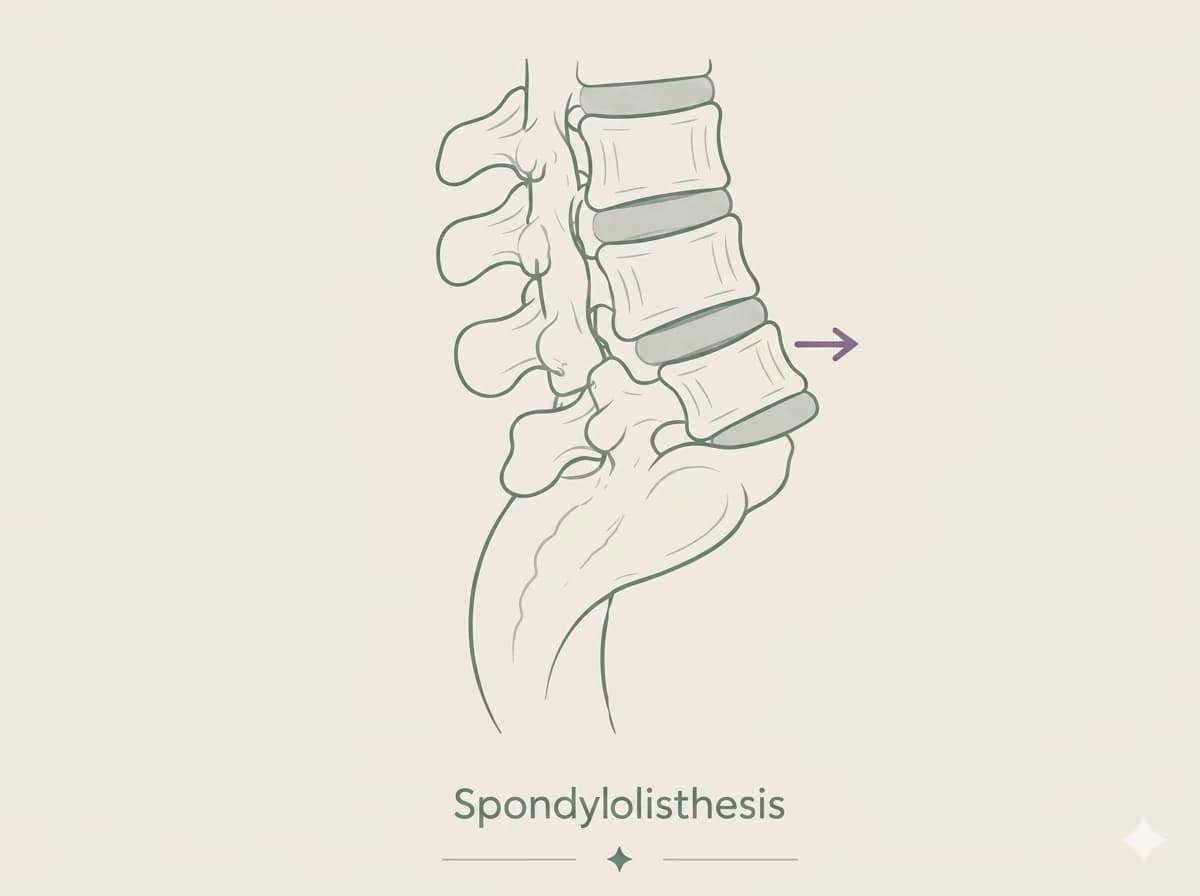
Spondylolisthesis
Understand vertebral slipping, why it happens, how it causes back or leg symptoms, when treatment is needed and when surgery may be considered.
CARENYX provides educational health information and does not replace an examination, diagnosis or personalised treatment plan from a qualified medical professional.
What Is Spondylolisthesis?
What Is a Vertebra?
Your spine is built from a real, stacked column of individual bones called vertebrae, each one connected to the next by discs, ligaments, and small joints — together, this real, flexible structure supports your body's weight while protecting the nerves running through it.

What Does 'Slippage' Mean?
Spondylolisthesis simply means one vertebra has genuinely shifted forward relative to the one directly below it — the real, literal Greek origin of the word means "vertebra" and "slippage." This isn't the dramatic image the word might suggest; it's typically a real, gradual, partial shift, not a bone falling out of place.
What Happens to the Spinal Canal and Nerves?
When a vertebra shifts forward, it can genuinely narrow the space available for the spinal canal and the nerve roots passing through it — this narrowing is what can cause the back or leg symptoms covered later on this page, though real, current evidence shows this narrowing doesn't always cause noticeable symptoms at all.
The Difference Between Spondylolisthesis and Spondylolysis
Spondylolysis is a real, specific stress fracture in a small bony bridge (the pars interarticularis) connecting parts of a vertebra — genuinely distinct from spondylolisthesis itself, though the two are closely related: a spondylolysis fracture can, in some people, destabilize the vertebra enough that it goes on to slip forward, becoming spondylolisthesis. Not everyone with spondylolysis develops spondylolisthesis, and not all spondylolisthesis comes from spondylolysis.
Why a Person May Have No Symptoms
Here is a real, genuinely important, reassuring fact: many people with spondylolisthesis — including some with meaningful slippage on imaging — have no symptoms at all, and may only discover it incidentally on imaging done for an unrelated reason. Real, current evidence shows the amount of slippage doesn't reliably predict whether someone will have symptoms.
Why Some Patients Develop Back Pain or Leg Pain
When spondylolisthesis does cause symptoms, it's genuinely because of a combination of real, specific factors: the mechanical instability at the affected level, and — when the slippage narrows the space for nerve roots — genuine nerve compression, sometimes causing leg symptoms alongside or instead of back pain. Real, current guidance is clear that treatment decisions are based on your actual symptoms and clinical findings, not the slippage percentage alone.
Types of Spondylolisthesis
Degenerative
The real, most common type in adults — resulting from age-related changes in the disc and facet joints that gradually weaken the structures normally preventing forward slippage, typically appearing after age 50. This is genuinely the type most CARENYX patients are asking about when they search for this condition.
Isthmic
Results from a real, specific defect in the pars interarticularis (often the spondylolysis stress fracture described above), genuinely more relevant to younger patients and athletes, sometimes beginning in adolescence, particularly with sports involving repetitive spinal extension.
Dysplastic
A real, congenital type — present from birth, due to an abnormal shape of the vertebra or sacrum that doesn't properly resist forward slippage. This type is genuinely more relevant to younger patients, since it's present from birth rather than developing later, and carries a real, higher risk of progression given the underlying structural difference.
Traumatic
Results from a real, acute fracture of the spine's posterior structures — genuinely distinct from an isthmic pars fracture — typically from significant, high-energy trauma like a serious fall or accident, relevant across all ages.
Pathological
A real, genuinely rarer type — resulting from an underlying disease process (like a bone tumor, infection, or a metabolic bone condition such as significant osteoporosis) weakening the vertebra's structure enough to allow slippage, relevant across ages depending on the underlying condition.
Iatrogenic (Including Post-Surgical)
Iatrogenic means genuinely resulting from medical treatment itself — for spondylolisthesis specifically, this most often means post-surgical spondylolisthesis, developing after a prior spine surgery (particularly extensive decompression) has removed enough supporting bone or tissue to allow new slippage. This type is real and relevant at any age where prior spine surgery has occurred, and is one real, important reason surgical planning carefully balances adequate decompression against preserving structural stability.
Grading — Understanding the Meyerding System
Doctors describe spondylolisthesis severity using the real, standard Meyerding classification, based on the percentage of forward slippage visible on imaging:
Grade I: less than 25% slippage. Grade II: 25 to 50%. Grade III: 50 to 75%. Grade IV: 75 to 100%. Grade V, also called spondyloptosis: greater than 100%, meaning the vertebra has completely displaced off the one below it.
Here is a genuinely important point this page wants to state clearly and directly: your grade is one real, useful piece of information, not the whole picture, and it does not by itself determine whether you need surgery. Real, published data shows symptom severity doesn't always match the grade — some people with Grade I slippage have significant pain, while others with more advanced slippage remain entirely comfortable. What real, current evidence does show is that higher-grade slippage (Grade III–IV) is more consistently associated with symptoms — back pain in roughly 55–91% of these patients, and radiating leg symptoms in roughly 44–55% — but this is a real, general association, not a rule that applies to every individual case. Your actual symptoms, neurological findings, spinal alignment, and how you respond to initial treatment all matter alongside your grade, and are exactly what your doctor weighs together when discussing your specific, individual treatment path.
Why Does It Happen?
Disc Degeneration
Age-related disc changes reduce the disc's normal, real contribution to spinal stability, genuinely contributing to degenerative spondylolisthesis specifically.
Facet Joint Degeneration
Arthritic changes in the small facet joints reduce their real, normal role in resisting forward slippage — a significant, recognized contributor to degenerative spondylolisthesis.
Pars Defect
A stress fracture in the pars interarticularis (spondylolysis) is the real, direct cause of isthmic spondylolisthesis specifically, sometimes progressing to genuine slippage over time.
Repetitive Stress
Real, repeated loading of the lower back — particularly repetitive extension movements — can contribute to pars stress fractures over time, genuinely relevant to certain occupations and athletic activities specifically, not to ordinary daily posture or routine activity.
Sports
Activities genuinely involving repetitive spinal extension — gymnastics, cricket fast bowling, certain swimming strokes, and similar — carry a real, recognized, elevated association with isthmic spondylolisthesis, particularly in adolescent athletes still growing.
Trauma
Significant, high-energy trauma can directly cause traumatic spondylolisthesis through an acute fracture of the spine's posterior structures.
Congenital Abnormalities
A real, structural difference present from birth — an abnormally shaped vertebra or sacrum — underlies dysplastic spondylolisthesis specifically, genuinely distinct from the other, acquired types.
Previous Surgery
Prior spine surgery, particularly extensive decompression, can genuinely reduce the structural support at a level enough to allow new, iatrogenic slippage — one real, important reason surgical planning carefully balances adequate decompression against preserving structural stability.
Age-Related Changes
Beyond any single specific cause, the general, cumulative effect of aging on discs, joints, and ligaments is the real, most common underlying contributor to degenerative spondylolisthesis specifically, typically becoming relevant from the 50s onward. A real, important, honest clarification: ordinary daily posture and routine physical activity are not established causes of spondylolisthesis — the real risk factors above involve specific, cumulative, or acute mechanical stresses genuinely different from everyday movement.
Common Symptoms
Low Back Pain
Often the real, first symptom when spondylolisthesis does cause symptoms — sometimes worsened by standing, walking, or backward bending (extension), and eased by sitting or bending forward.
Buttock Pain
Pain in the buttock region is a real, common accompanying symptom, sometimes reflecting the same mechanical instability causing low back pain.
Leg Pain
When slippage narrows the space for a nerve root, real leg pain can result, following the specific path of the affected nerve.
Sciatica
A real, specific radiating pattern down the leg, reflecting genuine sciatic nerve involvement when the slippage compresses the relevant nerve root — covered in complete detail in CARENYX's Sciatica Knowledge Centre.
Numbness
Reduced sensation in a real, specific area of the leg or foot, matching the affected nerve's distribution, reflects genuine nerve involvement.
Tingling
Tingling sensations, often alongside numbness in the same real, specific distribution, reflect nerve irritation from the narrowed space.
Weakness
Weakness in specific leg muscles is real, clinically significant — more so than pain alone — and is specifically covered as a surgical consideration later on this page.
Hamstring Tightness
A real, genuinely common and somewhat distinctive accompanying symptom — tight, sometimes painful hamstrings, particularly with higher-grade slippage, reflecting compensatory muscle tension related to the spinal instability.
Difficulty Standing
Discomfort or instability with prolonged standing is a real, common symptom, often specifically related to the extension position standing places the spine in.
Difficulty Walking
Real, genuine difficulty walking meaningful distances can occur, particularly when slippage causes an accompanying spinal stenosis pattern — covered in complete detail in CARENYX's Spinal Stenosis Knowledge Centre.
Pain With Extension
A real, distinctive pattern — pain specifically worsening with backward bending — reflects the mechanical narrowing that extension causes at the level of slippage.
Reduced Activity Tolerance
A genuine, gradual reduction in how much activity feels comfortable, without necessarily a single, severe symptom — a real, meaningful pattern worth mentioning to your doctor even without dramatic pain.
Some People Have No Symptoms At All
It's worth restating directly here: many people with spondylolisthesis experience none of the symptoms above — real, current evidence consistently shows the presence and degree of slippage doesn't reliably predict whether someone will have symptoms at all.
Red Flags — When Urgent Medical Evaluation Is Required
⚠ Seek urgent medical evaluation immediately — the same day, not a routine appointment — if you have:
- New loss of bladder control
- New loss of bowel control
- Saddle numbness (numbness in the area between your legs, inner thighs, or around your genitals)
- Progressive weakness — leg weakness that is getting noticeably worse over hours or days
- Foot drop — new difficulty lifting the front of your foot, causing your toes to catch or drag while walking
- Rapidly worsening neurological symptoms of any kind
- Fever combined with severe back pain
- Significant trauma (a serious fall or accident) followed by new back or leg symptoms
- A known history of cancer, alongside new, severe symptoms
In rare, extreme cases, spondylolisthesis can contribute to cauda equina syndrome — severe compression of the nerve bundle at the bottom of the spinal cord — a genuine emergency where prompt evaluation, and sometimes emergency surgery, can meaningfully prevent permanent nerve damage. We want to be direct and honest here, not falsely reassuring: if any of these specific symptoms apply to you, this is not a "wait and see" situation — please seek evaluation right away.
How Is It Diagnosed?
Medical History
Your doctor starts with a real, detailed history — when symptoms began, what makes them better or worse, and screening directly for the red flags described above.
Physical Examination
A real, thorough exam checks your posture, spinal range of motion, and specific movements — like extension — that may reproduce your symptoms.
Neurological Examination
Testing reflexes, strength in specific leg muscles, and sensation helps your doctor assess whether — and how significantly — a nerve root is genuinely affected.
Standing X-rays
A real, standard, first diagnostic test — importantly taken while you're standing, since weight-bearing genuinely shows real slippage that can be less apparent lying down.
Flexion-Extension X-rays
In selected patients, dynamic X-rays — taken bending forward and backward — can reveal real, genuine spinal instability (movement between vertebrae) not visible on a single, static image. Your doctor decides whether this specific additional test is useful for your particular situation, rather than it being needed for everyone.
MRI
MRI directly shows real, soft-tissue detail — the discs, nerve roots, and any nerve compression from the slippage — genuinely useful when leg symptoms are present or surgery is being considered, though not always needed for straightforward, mild cases without neurological symptoms.
CT Scan
A CT scan shows real, detailed bony anatomy — particularly useful for clearly visualizing a pars defect (spondylolysis) or for detailed pre-surgical planning.
Evaluation for Pars Defects
When isthmic spondylolisthesis is suspected, real, specific imaging — sometimes including CT or specialized X-ray views — helps directly confirm and characterize any pars interarticularis defect.
Assessment of Nerve Compression
Combining your real, specific symptoms, exam findings, and MRI results, your doctor assesses whether — and how significantly — a nerve root is genuinely compressed, real, important information directly guiding your treatment discussion.
Non-Surgical Management
Activity Modification
Real, current guidance favors modifying — not eliminating — activities that clearly worsen your specific symptoms, particularly reducing repetitive extension movements for isthmic cases specifically, while staying otherwise reasonably active.
Walking
Regular walking is a real, valuable, low-impact activity many patients tolerate well, genuinely supporting general fitness and function alongside your broader treatment plan.
Physiotherapy
Real, current evidence supports physiotherapy as a genuine, first-line approach — targeted exercise, education, and gradual progression help many patients manage symptoms effectively without surgery.
Core Strengthening
Real, targeted core stabilization genuinely supports the spine's structural stability at the level of slippage — covered in complete, practical detail in the Exercise section directly below.
Hamstring Flexibility
Given hamstring tightness is a real, genuinely common accompanying symptom, gentle, appropriate hamstring stretching is often a real, valuable, targeted part of a comprehensive treatment plan.
Weight Management Where Appropriate
Where relevant to your individual situation, maintaining a healthy body weight can genuinely reduce mechanical load on the lower spine. CARENYX's own Protein Calculator, grounded in real ICMR-NIN 2020 guidelines, offers a genuine, evidence-based starting point for the nutritional side.
Pain Medication
Pain medication can genuinely support your ability to stay active and participate in physiotherapy during a flare. This should always be discussed with, and guided by, a qualified clinician — please don't self-prescribe or adjust dosing on your own.
Anti-Inflammatory Medication Where Appropriate
NSAIDs may be genuinely appropriate for some patients during flares, though real, current guidance favors defined, limited periods of use rather than continuous, long-term use. As with all medication on this page, this decision should be made together with a qualified clinician, not self-directed.
Neuropathic Pain Medication Where Appropriate
For genuine, significant nerve-related leg symptoms specifically, certain neuropathic (nerve-pain-specific) medications may be appropriate for some patients — again, a decision made and monitored directly by your doctor, never self-prescribed.
Injections in Selected Patients
An epidural steroid injection may provide real, meaningful, though typically time-limited relief for selected patients with significant nerve-related symptoms, particularly to help tolerate physical therapy — a real, supportive tool within a broader plan, not a stand-alone cure, and a decision made together with your doctor based on your specific situation.
Lifestyle Modification
Not smoking, general activity, and attention to the broader prevention principles covered later on this page all genuinely support better outcomes alongside any specific medical treatment.
Exercise
Which Types of Exercise May Help
Real, current evidence generally favors core stabilization and gentle mobility work over exercises emphasizing significant spinal extension, particularly for isthmic spondylolisthesis specifically — though the genuinely right, specific mix for you depends on your individual type, symptoms, and how your body responds, which is exactly why this page doesn't prescribe one fixed program for every reader.
Why Core Strength Matters
Your deep core muscles genuinely provide real, meaningful structural support to the spine, helping stabilize the level of slippage — this is why core stabilization exercise features so prominently across real, current, evidence-based guidance for this condition.
Why Gradual Progression Matters
Building exercise tolerance gradually, rather than immediately attempting a demanding program, genuinely reduces real risk of aggravating symptoms while still building the strength and function that support your recovery over time.
Why Symptoms Should Guide Progression
Your own, real, individual response to each exercise — not a fixed, generic schedule — should genuinely guide how quickly you progress; an exercise that consistently increases your specific symptoms is a real, meaningful signal to modify or pause that particular movement, not necessarily all exercise.
When Exercise Should Be Stopped
Stop a specific exercise and consult your physiotherapist or doctor if it genuinely, consistently increases your pain, causes new numbness or tingling, or produces any of the red flags described earlier on this page.
When Professional Assessment Is Required
A physiotherapist's individualized, hands-on assessment genuinely matters more for spondylolisthesis than for many other spine conditions, given the real, meaningful differences in appropriate exercise selection between types (particularly isthmic versus degenerative) and individual severity — this page provides real, general education, not a substitute for that personalized guidance.
CARENYX's own reviewed Exercise Library includes real, relevant options worth discussing with your physiotherapist: Bird Dog, Dead Bug, and Bridge for core stabilization, Pelvic Tilts as a gentle, foundational option, and Hamstring Stretch given how commonly hamstring tightness accompanies this condition.
When Should I See a Spine Surgeon?
About This Decision Guide
This decision guide is real, general educational guidance to help you understand roughly where your situation might fall — it is not a diagnostic tool, and it cannot replace an actual examination by a qualified doctor. If you're ever genuinely uncertain which category applies to you, choosing the more cautious, prompt option is always the reasonable, safe choice.
Emergency Assessment
Go to an emergency department right now
Severe neurological deterioration or cauda equina symptoms — a real, genuine emergency.
- • New loss of bladder or bowel control
- • Saddle numbness
- • Rapidly worsening leg weakness
- • New foot drop
Prompt Specialist Assessment
Within days
Progressive weakness warrants prompt, though not emergency-department-level, specialist evaluation.
- • New or worsening leg weakness, without the emergency features above
- • Progressively reducing walking tolerance
Specialist Assessment
A scheduled specialist appointment is reasonable
Persistent pain despite appropriate conservative treatment warrants specialist evaluation, without urgency.
- • Back or leg pain continuing despite a genuine trial of physiotherapy and conservative care
- • Symptoms significantly affecting your daily function
Conservative Care / Routine Assessment
A routine medical appointment is reasonable
Mild symptoms without neurological deficit are appropriately managed with conservative care and routine follow-up.
- • Mild, stable back pain without leg symptoms
- • An incidental finding on imaging done for another reason, without symptoms
When Is Surgery Considered?
Surgery may genuinely be considered in selected patients, based on your specific, individual clinical picture — never automatically determined by your grade alone. Real, current indications your doctor weighs include:
Persistent, disabling symptoms despite a genuine, appropriate trial of non-operative treatment. A significant neurological deficit — meaningful weakness or nerve dysfunction, not mild or transient symptoms. Progressive neurological deterioration — real, ongoing worsening over time, rather than stable, unchanging symptoms. Significant nerve compression confirmed on imaging, correlating with your actual symptoms. Genuine spinal instability, identified in appropriate clinical circumstances — for instance, through the flexion-extension X-rays described in the Diagnosis section. Structural problems where surgery is genuinely, clinically justified based on your complete individual picture.
We want to state this directly: a specific Meyerding grade does not, by itself, automatically require surgery. Many people with even significant slippage manage well long-term without ever needing surgery, while some people with lower-grade slippage but genuinely significant, persistent symptoms may reasonably consider it. This is always a real, individualized decision made together with your surgeon, weighing your complete clinical picture.
Surgical Options
Decompression
Removing the specific tissue — bone, thickened ligament, or disc material — narrowing the space for the affected nerve root, directly relieving nerve-related symptoms. For some patients with genuine spinal stability, decompression alone may be appropriate.
Decompression With Fusion
When real, genuine instability is present alongside nerve compression, fusion — stabilizing the affected vertebrae together — is often added to decompression. Real, current NASS guidelines specifically support this combined approach, rather than decompression alone, for degenerative lumbar spondylolisthesis needing surgery.
Minimally Invasive Approaches
Real, modern techniques using smaller incisions and specialized instruments can achieve the same real surgical goals with less tissue disruption than traditional open surgery, for appropriately selected patients — generally associated with less post-operative pain and a faster return to normal activity.
Interbody Fusion Techniques Where Appropriate
For appropriately selected patients, real, specific interbody fusion techniques — placing a supportive spacer directly in the disc space alongside fusion — can provide additional real structural support and help restore normal spinal alignment.
Why Different Patients May Require Different Operations
Your specific type of spondylolisthesis, grade, the presence or absence of instability, which nerve roots are involved, and your overall health all genuinely factor into which real, specific surgical approach your surgeon recommends — there is no single, universal operation appropriate for every patient.
Expected Benefits
Real, published outcome data shows good-to-excellent results for the large majority of appropriately selected patients, with nerve-related leg symptoms typically improving most reliably.
Possible Risks
Like any surgery, spondylolisthesis surgery carries real, individual risks your surgeon will discuss directly, including infection, nerve injury, and — if fusion is performed — hardware-related complications. Real, published rates of significant complications are genuinely low for appropriately selected patients.
Hospital Stay
Real, typical hospital stay ranges from a day or two for decompression alone to several days when fusion is also performed.
Pain After Surgery
Some real, expected post-surgical pain is normal, generally well-managed with appropriate medication, and typically improving meaningfully within the first days to weeks.
Walking After Surgery
Walking typically begins the same day or the day after surgery, with assistance, as a real, deliberate part of your recovery care.
Return to Work
This varies significantly by your specific procedure and job demands — covered in complete, real, stage-by-stage detail in the Recovery Roadmap section of this page.
Need for Physiotherapy
Guided physical therapy after surgery genuinely improves real, long-term functional outcomes and helps rebuild the strength that supports lasting recovery.
Potential Need for Future Treatment
New, real degeneration at an adjacent spinal level, sometimes years later, is a genuinely recognized long-term consideration, particularly after fusion — this is one real reason the prevention principles covered later on this page matter even after successful surgery.
Recovery Roadmap
A real, general recovery pathway. Actual recovery varies according to the operation, age, neurological status, general health and your surgeon's specific advice.
Walking
Walking begins the same day or the day after surgery, with assistance, as a real, deliberate part of care.
Sitting
Brief, supported sitting periods, gradually increasing as comfort allows.
Stairs
Only with direct supervision, if genuinely needed before discharge.
Driving
Not applicable — you're in the hospital.
Office Work
Not applicable.
Household
Not applicable.
Lifting
Avoid lifting anything at all during this stage.
Exercise
Only the assisted walking described above.
Gym
Not applicable.
Travel
Not applicable.
Follow-Up
Your surgical team will confirm your specific follow-up schedule before discharge.
Preventing Future Problems
Maintain Healthy Body Weight
Genuinely reducing ongoing mechanical load on your lower spine — CARENYX's own Nutrition+ platform, including an ICMR-based Protein Calculator, offers a real, evidence-based starting point for the nutritional side.
Regular Walking
A real, sustainable, low-impact habit with broad, evidence-supported benefit for long-term spine health, cardiovascular fitness, and general function.
Strength Training
Real, appropriate, guided strength training — genuinely beneficial for long-term function, with proper technique mattering more than the amount of weight lifted.
Flexibility
Maintaining real, general hip and spinal flexibility — including ongoing hamstring flexibility work — supports comfortable movement and reduces compensatory strain patterns.
Bone Health
Real, strong bone health supports your spine's overall structural integrity — covered in complete, evidence-based detail in CARENYX's dedicated Osteoporosis article, genuinely relevant particularly for older adults.
Safe Lifting
Real, evidence-based technique — bending your knees and hips, keeping the load close to your body, using your legs rather than rounding your lower back — a genuinely directly actionable, real prevention measure.
Avoid Smoking
Smoking is a real, well-established, independent risk factor for accelerated disc degeneration and reduced spinal blood flow — quitting genuinely benefits your spine specifically.
Ergonomics
Real, practical workstation and daily-activity adjustments — supportive seating, appropriate lifting technique for repeated tasks — genuinely reduce cumulative spinal strain over time.
Gradual Return to Sport
For athletes specifically, particularly with isthmic spondylolisthesis, a real, structured, gradual return-to-sport progression — rather than an abrupt return to full training — genuinely reduces re-injury risk.
Long-Term Fitness
Beyond any single measure, sustained, genuine engagement with CARENYX Fit and CARENYX Nutrition — regular movement, appropriate strength work, and good nutrition together — supports your spine's long-term resilience more than any one intervention alone.
32 Myths vs Facts
Myth
Every slip means surgery.
Fact
Most people with spondylolisthesis, including some with meaningful slippage, are managed successfully without surgery — it's reserved for selected patients based on their complete clinical picture.
Myth
All spondylolisthesis gets worse over time.
Fact
Many cases remain genuinely stable for years; progression varies considerably between individuals and isn't automatic.
Myth
Exercise is dangerous with spondylolisthesis.
Fact
Real, current evidence supports appropriately guided exercise, particularly core stabilization, as a genuine, first-line treatment approach.
Myth
Bed rest is the best treatment.
Fact
Real, current guidance favors staying appropriately active; prolonged bed rest can slow recovery rather than support it.
Myth
MRI findings always explain your pain.
Fact
The amount of slippage doesn't reliably predict symptoms — some people with significant slippage on MRI have no pain at all.
Myth
Fusion is always required for surgery.
Fact
Decompression alone may be appropriate for some patients without genuine instability; fusion is added specifically when instability is present.
Myth
Walking damages the spine if you have spondylolisthesis.
Fact
Walking is genuinely one of the most consistently recommended activities, supporting function without causing structural harm for most patients.
Myth
Your Meyerding grade alone determines whether you need surgery.
Fact
Grade is one real, useful piece of information — your actual symptoms, neurological findings, and response to treatment matter just as much.
Myth
Spondylolisthesis only affects older adults.
Fact
Isthmic and dysplastic types are genuinely more relevant to younger patients and athletes, sometimes beginning in adolescence.
Myth
Ordinary posture causes spondylolisthesis.
Fact
Real risk factors involve specific, cumulative, or acute mechanical stresses — genuinely different from everyday posture or routine activity.
Myth
A diagnosis of spondylolisthesis means you'll eventually be disabled.
Fact
The large majority of people, including many who need surgery, continue living active, functional lives with appropriate management.
Myth
Spondylolysis and spondylolisthesis are the same thing.
Fact
Spondylolysis is a stress fracture; spondylolisthesis is the actual forward slippage — related but genuinely distinct conditions.
Myth
Surgery guarantees complete, permanent symptom relief.
Fact
Real, published outcomes show good-to-excellent results for most appropriately selected patients, but complete resolution isn't guaranteed for everyone.
Myth
You should avoid all core exercise if you have spondylolisthesis.
Fact
Core stabilization is genuinely one of the most consistently evidence-supported treatments, helping stabilize the affected level.
Myth
Higher-grade slippage always causes more severe symptoms.
Fact
Symptom severity doesn't always match the grade — some people with lower grades have significant pain, while others with higher grades remain comfortable.
Myth
Hamstring tightness with spondylolisthesis means you need to stretch aggressively.
Fact
Gentle, appropriate hamstring stretching genuinely helps, but aggressive stretching isn't necessarily better and should be guided by a physiotherapist.
Myth
You can definitively diagnose your own type of spondylolisthesis from symptoms alone.
Fact
Real, confident classification requires imaging and a professional exam — not something to determine from symptoms alone.
Myth
Decompression-alone surgery is always inferior to fusion.
Fact
For appropriately selected patients without genuine instability, decompression alone can be an appropriate, effective option.
Myth
Athletes with isthmic spondylolisthesis can never return to sport.
Fact
Many young athletes return to their sport with appropriate treatment and a gradual, guided return-to-sport progression.
Myth
Once you've had spondylolisthesis surgery, you'll never need treatment again.
Fact
New degeneration at an adjacent level, sometimes years later, is a genuinely recognized possibility — ongoing prevention habits matter even after successful surgery.
Myth
Standing X-rays and lying-down X-rays show the same thing.
Fact
Standing, weight-bearing X-rays genuinely show real slippage that can be less apparent when lying down.
Myth
If your symptoms are mild, imaging isn't worth doing at all.
Fact
This is a real, individual decision your doctor makes based on your specific situation — imaging isn't automatic, but isn't universally unnecessary either.
Myth
Weight loss alone will fix spondylolisthesis.
Fact
Weight management is one real, contributing factor among several; it reduces mechanical load but doesn't reverse the underlying slippage.
Myth
Pain medication is a safe long-term solution you can manage yourself.
Fact
Medication decisions should always be made and monitored by a qualified clinician, not self-prescribed or self-adjusted.
Myth
Epidural injections are a permanent fix.
Fact
They're a real, supportive, typically time-limited tool for managing symptoms, not a stand-alone, permanent cure.
Myth
Congenital (dysplastic) spondylolisthesis is the same as age-related spondylolisthesis.
Fact
They're genuinely different — dysplastic is present from birth with distinct progression risk; degenerative develops later from age-related change.
Myth
Physiotherapy is only useful after surgery.
Fact
Physiotherapy is a real, first-line, evidence-supported treatment before surgery is ever considered, helping many people avoid needing it at all.
Myth
Every patient with spondylolisthesis needs the exact same exercise program.
Fact
The appropriate exercise approach genuinely differs by type, severity, and individual response — a one-size-fits-all program isn't appropriate.
Myth
Spondylolisthesis surgery is always a major, high-risk operation.
Fact
Real, published complication rates are genuinely low for appropriately selected patients, and many procedures use minimally invasive techniques.
Myth
Nerve compression from spondylolisthesis is always permanent.
Fact
Many patients experience meaningful, real improvement in nerve-related symptoms after appropriate treatment, particularly surgery when indicated.
Myth
You can safely skip follow-up appointments once you feel better.
Fact
Real, periodic follow-up — especially after fusion surgery — helps confirm healing progress and catch any new, real changes early.
Myth
A family history of spondylolisthesis means you'll definitely develop it too.
Fact
Some types have a genetic or congenital component, but having a family history doesn't guarantee you'll develop the condition.
110 Frequently Asked Questions
Showing 110 of 110 questions.
I've Been Diagnosed With Spondylolisthesis — What Should I Do Next?
Tap whichever real, current situation best describes you — this doesn't diagnose you, it just points you toward relevant CARENYX resources.
Related CARENYX Content
References
- 1. North American Spine Society (NASS). Evidence-Based Clinical Guideline: Diagnosis and Treatment of Degenerative Lumbar Spondylolisthesis.
- 2. American Academy of Orthopaedic Surgeons (AAOS). Spondylolisthesis patient education.
- 3. StatPearls (NCBI Bookshelf). Spondylolisthesis — real Wiltse classification and Meyerding grading.
- 4. Radiopaedia. Spondylolisthesis — real classification and imaging reference.
- 5. Surgical and non-surgical management of spondylolisthesis: a comprehensive review. PMC.
- 6. CARENYX Knowledge Library. Spondylolisthesis (15-spondylolisthesis.md) — real, already-reviewed grading and red flags reused directly for consistency.