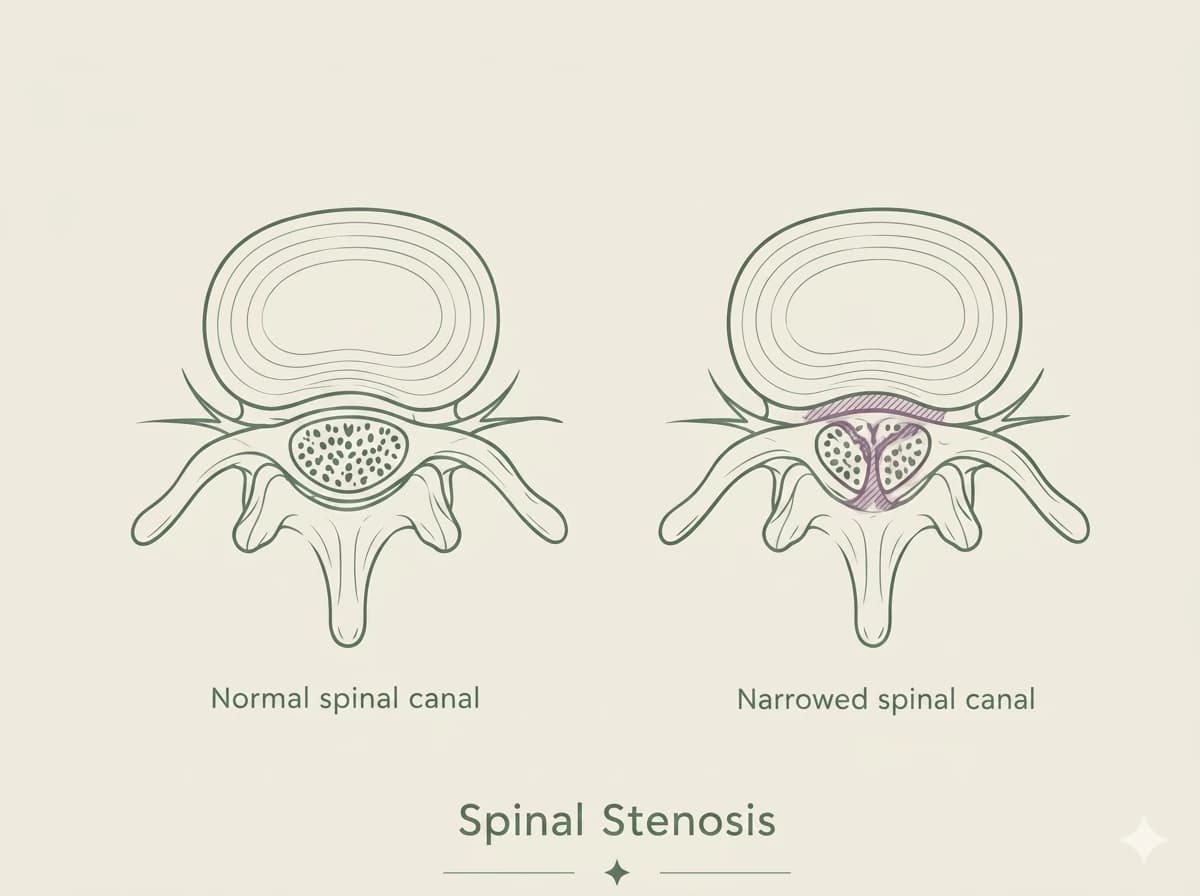
Spinal Stenosis
Understand why walking becomes difficult, what causes spinal stenosis, available treatments, surgical options and how to regain an active life.
This page provides educational information and is not a substitute for consultation with a qualified spine specialist. It does not replace your own doctor's evaluation of your specific symptoms and MRI findings.
What Is Spinal Stenosis?
What Is the Spinal Canal
The spinal canal is the real, protective bony tunnel running through the center of your spine, housing your spinal cord in the neck and upper-to-mid back, and the cauda equina (a bundle of nerve roots) further down in the lower back, since your actual spinal cord ends around the L1-L2 level in most adults.
A healthy spinal canal provides genuinely ample space for these structures to sit without pressure — spinal stenosis describes the real, gradual or sometimes congenital narrowing of this space.

What Becomes Narrow
Real, current understanding identifies several structures that can narrow the canal: thickened ligaments (particularly the ligamentum flavum), bulging or herniated discs, bone spurs from arthritic joints, and thickened facet joints — often several of these changes occurring together as part of the same broader, real degenerative process.
Why Nerves Get Compressed
As the canal narrows, real, physical space for the spinal cord or nerve roots genuinely decreases, and specific positions — particularly standing and walking, which naturally extend the spine — can narrow the space further still, temporarily compressing or reducing blood flow to the affected nerves. This exact mechanism is why symptoms so characteristically worsen with standing and walking and ease with sitting or bending forward, covered in complete detail in the Neurogenic Claudication section below.
Lumbar Stenosis
Lumbar spinal stenosis — narrowing in the lower back — is the real, most common form, affecting the cauda equina nerve roots rather than the spinal cord itself, since the cord has already ended by this level. This is exactly why lumbar stenosis typically causes leg symptoms (neurogenic claudication) rather than the broader, whole-body pattern seen with cervical or thoracic stenosis.
Cervical Stenosis
Cervical spinal stenosis — narrowing in the neck — genuinely can compress the spinal cord itself, since the cord is still present at this level. This can lead to cervical myelopathy, a real, more serious condition covered in complete detail in CARENYX's dedicated Cervical Myelopathy article, with a distinctive symptom pattern (hand clumsiness, balance problems, sometimes urinary urgency) different from lumbar stenosis.
Thoracic Stenosis
Thoracic spinal stenosis — narrowing in the mid-back — is genuinely the least common of the three real locations, but like cervical stenosis, it can compress the spinal cord directly, since the cord is still present through this level too, potentially producing myelopathy-type symptoms in the legs and, less commonly, affecting balance and coordination.
Why Does It Occur?
Age-Related Degeneration
Age is the real, single strongest risk factor for spinal stenosis — the large majority of cases develop gradually over decades as a combination of disc, ligament, and joint changes accumulate, most commonly becoming symptomatic from the 50s onward.
Disc Degeneration
As discs lose height and hydration over years, they can bulge outward into the canal space, contributing to real, gradual narrowing — covered in complete detail in CARENYX's dedicated Degenerative Disc Disease article.
Facet Joint Arthritis
The small joints at the back of each vertebral level can develop real, arthritic thickening over time, encroaching on the canal space — a genuinely common, significant contributor to stenosis, particularly at the lateral recess where nerve roots exit.
Thickened Ligamentum Flavum
The ligamentum flavum is a real, specific ligament running along the back of the spinal canal, and its age-related thickening is one of the most significant, common contributors to central canal narrowing — genuinely central to why extension (standing, walking) worsens symptoms, since real, published research shows this ligament buckles further inward during spinal extension.
Bone Spurs
Osteophytes (bone spurs) form as the body's real, natural response to joint instability and wear, but can genuinely encroach on the available canal space, particularly when they develop at the edges of vertebral bodies or facet joints adjacent to the canal.
Congenital Stenosis
Some people are genuinely born with a naturally narrower spinal canal, meaning even modest, ordinary age-related change is more likely to become symptomatic earlier than in someone with a naturally more generous canal — a real, individual anatomical factor your surgeon may specifically note on imaging.
Previous Surgery
Scar tissue formation or adjacent-segment changes after prior spine surgery can genuinely contribute to new or recurrent stenosis at the same or a nearby level — a real, recognized long-term consideration covered further in this page's Preventing Future Problems section.
Trauma
A significant fall, accident, or fracture can directly narrow the canal or destabilize the spine in ways that lead to stenosis, either immediately or gradually over the following months and years.
Tumours
A genuinely rare cause — a tumor within or near the spinal canal can directly narrow the available space, real, current guidance flags this specific possibility particularly with a personal cancer history or unexplained weight loss.
Infections
Spinal infections are a genuinely rare but real and serious cause of canal narrowing through inflammation and tissue swelling, particularly relevant with real risk factors like fever, recent infection elsewhere, or a weakened immune system.
Common Symptoms
Back Pain
Lower back pain is a real, common accompanying symptom of lumbar stenosis, though real, current guidance notes that back pain alone, without leg symptoms, is generally not thought to be caused by stenosis specifically.
Neck Pain
Neck pain commonly accompanies cervical stenosis, though — similar to the lumbar pattern — the more distinctive, real diagnostic symptoms are the arm and hand-related changes covered separately below, not neck pain alone.
Leg Pain
Real, characteristic leg pain from lumbar stenosis — the hallmark of neurogenic claudication, covered in complete detail below — typically affects both legs (though one-sided presentations occur) and follows the real, distinctive pattern of worsening with walking and easing with sitting or bending forward.
Arm Pain
Arm symptoms suggest cervical stenosis affecting a specific nerve root, or — if broader hand clumsiness and coordination changes are also present — potential spinal cord involvement (myelopathy), covered in CARENYX's dedicated Cervical Myelopathy article.
Numbness
Numbness in a real, specific pattern — both legs for lumbar stenosis, hands or arms for cervical stenosis — reflects genuine nerve or cord compression, and its specific distribution helps your doctor localize the affected level.
Tingling
Tingling sensations, often accompanying numbness in the same real, specific distribution, reflect nerve or cord irritation and are a real, common accompanying symptom across all three stenosis locations.
Weakness
Real, current guidance treats weakness — whether in the legs (lumbar) or hands and arms (cervical) — as more clinically significant than pain alone, and it's specifically covered as a surgical consideration later on this page.
Difficulty Walking
Progressive difficulty walking meaningful distances is a real, hallmark symptom of lumbar stenosis specifically, directly reflecting the neurogenic claudication pattern — real, current assessment often specifically measures your actual walking distance and tolerance as a meaningful, trackable clinical marker.
Loss of Balance
Balance difficulty is a real, more specific concern with cervical or thoracic stenosis affecting the spinal cord itself, since the cord carries the nerve signals coordinating balance and position sense — a genuinely important symptom to mention directly to your doctor.
Neurogenic Claudication
Neurogenic claudication is the real, classic, hallmark symptom pattern of lumbar spinal stenosis — pain, heaviness, numbness, or weakness in one or both legs that comes on with standing or walking, and genuinely eases within minutes of sitting down or bending forward (like leaning on a shopping cart).
The real, underlying mechanism: standing and walking naturally extend your spine, which narrows an already-tight canal further still, temporarily compressing the nerve roots and reducing their blood flow — bending forward or sitting reverses this, genuinely opening the canal back up and relieving the compression.
A real, important, clinically useful distinction: this differs from vascular claudication (leg pain from poor blood circulation), which persists even standing still and improves specifically with rest, not with a position change alone — genuinely different from neurogenic claudication's specific, real relief with flexion. Since both conditions can cause similar leg pain with walking, your doctor may specifically ask about this distinction, since accurate diagnosis directly changes the appropriate real treatment path.
Red Flags — When Urgent Medical Consultation Is Required
⚠ Seek urgent medical attention immediately — the same day, not a routine appointment — if you have:
- Loss of bladder control, or new difficulty starting urination
- Loss of bowel control
- Rapidly progressive weakness — leg or arm weakness that is getting noticeably worse over hours or days
- Difficulty walking that is worsening rapidly, distinct from the more typical, gradual decline
- Severe numbness, particularly in the saddle area (inner thighs, groin, or around your genitals)
- Fever combined with severe back or neck pain
- A history of cancer, alongside new or worsening symptoms
- Night pain that is severe and doesn't ease with rest or position changes
These specific red flags can indicate cauda equina syndrome (for lumbar stenosis) or a rapidly progressing myelopathy (for cervical or thoracic stenosis) — both genuine emergencies where prompt evaluation, and sometimes emergency surgery, can meaningfully prevent permanent nerve damage. Severe central spinal stenosis can, in rare cases, cause cauda equina syndrome, the same real emergency described in CARENYX's Slip Disc and Sciatica Knowledge Centres.
A real, important, additional point specific to stenosis: while most stenosis symptoms progress gradually over months to years, a rapid, sudden worsening — rather than the more typical slow decline — is itself a real, meaningful signal worth prompt medical attention, even without the other specific red flags listed above.
Diagnosis
Medical History
Your doctor starts with a real, detailed history — when symptoms began, the specific real pattern of walking-related leg symptoms, how far you can typically walk before symptoms start, and screening directly for red flags. This history alone often strongly suggests stenosis before any exam or imaging.
Physical Examination
A real, thorough examination checks your posture, spinal range of motion, and general mobility. Real, published research notes that physical examination findings are often relatively normal at rest in stenosis, with reduced spinal extension being the most consistent real finding — this is exactly why history and functional walking assessment matter as much as the exam itself.
Neurological Examination
Testing reflexes, strength in specific muscle groups, and sensation helps your doctor assess whether nerve roots (lumbar) or the spinal cord itself (cervical or thoracic) are affected, and to what degree — genuinely important both for diagnosis and for tracking your condition over time.
Walking Assessment
Real, current practice often specifically measures your actual walking capacity — how far or how long you can walk before symptoms force you to stop — since this real, functional, trackable measure directly reflects how significantly stenosis is affecting your daily life, genuinely more meaningful for monitoring than imaging severity alone.
MRI: The Investigation of Choice
MRI is the real, gold-standard imaging test for spinal stenosis, and here's specifically why: it directly visualizes the spinal canal, the nerve roots or spinal cord within it, and every real contributing structure — thickened ligaments, bulging discs, bone spurs, and facet joint changes — in detail no other test can match, all without any radiation exposure.
Real, current guidance reserves MRI for red flags, significant or persistent symptoms, or when surgery is being considered — not as a routine, immediate first step for new, uncomplicated symptoms. A real, honest and important point: MRI severity doesn't always correlate perfectly with your actual symptoms — real, published research notes imaging findings correlate imperfectly with the clinical picture, which is exactly why your doctor interprets your MRI alongside your real, actual functional symptoms, not as a stand-alone diagnosis.
CT Scan
A CT scan shows real, detailed bony anatomy, sometimes used alongside or instead of MRI — particularly for patients who cannot have an MRI (certain implanted devices), or for detailed pre-surgical bony planning.
Dynamic X-rays
Dynamic (flexion-extension) X-rays — taken with you bending forward and backward — can reveal real, genuine spinal instability or slippage (spondylolisthesis) that might not be apparent on a single, static image, particularly relevant when your surgeon is considering whether fusion, not just decompression, may be needed.
Nerve Studies
Electrophysiological studies (like EMG, measuring electrical activity in muscles) are occasionally used for symptomatic patients with imaging-confirmed stenosis when the clinical picture needs further clarification — real, current guidance supports paraspinal EMG mapping in select cases, though it's genuinely less commonly needed than MRI for most patients.
Non-Surgical Treatment
Walking Programme
A real, structured, gradually progressive walking programme is a genuine, foundational part of stenosis management — even though walking itself triggers symptoms, real, current guidance supports building tolerance gradually rather than avoiding walking altogether, since inactivity genuinely worsens overall function and fitness over time.
Physiotherapy
Real, current evidence supports physiotherapy centered on flexion-based exercises — movements that open up the spinal canal — alongside core strengthening and general conditioning. CARENYX's Exercise Library includes real, relevant options: Lumbar Mobility (Seated Forward Lean), specifically suited to stenosis-related symptoms, along with Cat-Camel for gentle, general spinal mobility.
Medicines
NSAIDs are real, commonly recommended first-line options for pain and inflammation during flares, used for defined periods rather than continuously. For nerve-related leg symptoms specifically, real, current evidence supports certain neuropathic pain medications for some patients, prescribed and monitored directly by your doctor.
Lifestyle Changes
Not smoking, maintaining a healthy weight, and staying as physically active as your symptoms genuinely allow all support better real, long-term function — covered in complete, practical detail in the Preventing Future Problems section of this page.
Weight Reduction
Excess body weight increases real, mechanical load on the lower spine — real, current guidance supports that even modest, sustainable weight reduction can meaningfully reduce this cumulative load. CARENYX's own Protein Calculator, grounded in real ICMR-NIN 2020 guidelines, offers a genuine, evidence-based starting point.
Walking Aids
A real, simple walking aid — like a cane, or specifically a wheeled walker or shopping cart that encourages a slightly forward-leaning posture — can genuinely extend your comfortable walking distance by keeping your spine in a real, more favorable, flexed position, a practical, evidence-informed measure many patients find genuinely helpful.
Epidural Injections
An epidural steroid injection delivers anti-inflammatory medication directly near the affected nerve roots, providing real, meaningful relief for some patients during a significant flare, particularly to help tolerate physical therapy — a real, supportive, time-limited tool, not a stand-alone cure.
Activity Modification
Real, current guidance favors adapting how you do things — using a forward-leaning posture for tasks, taking seated breaks during longer walks — rather than avoiding activity altogether, genuinely supporting continued function and independence.
Expected Improvement
Real, published data shows many patients experience meaningful symptom improvement with conservative treatment, particularly for milder stenosis, though — unlike a disc herniation, which can genuinely resorb — the underlying canal narrowing itself doesn't reverse on its own, meaning conservative treatment focuses on real symptom management and functional improvement rather than structural change.
When Is Surgery Required?
Surgery is reserved for a real, smaller group of patients — many people manage stenosis successfully with conservative treatment for years. Real, current indications for surgery include:
Persistent disability significantly affecting your daily life despite genuine, appropriate conservative treatment. Walking distance progressively reducing over time, genuinely limiting your independence and quality of life. Significant or worsening weakness in the legs or arms. Balance problems, particularly with cervical or thoracic stenosis affecting the spinal cord. Myelopathy — spinal cord dysfunction from cervical or thoracic stenosis, where real, current guidance generally favors earlier surgical intervention given the real risk of progressive, potentially permanent decline without treatment. Cauda equina syndrome, which needs emergency surgery, not elective scheduling. Failure of conservative treatment more broadly.
A real, important point: for myelopathy specifically, the decision-making differs somewhat from ordinary lumbar stenosis — real, current guidance generally favors more proactive surgical consideration once moderate-to-severe myelopathy is confirmed, since the natural course is typically gradual, stepwise decline rather than spontaneous improvement.
Surgical Options
Lumbar Decompression
Decompression surgery removes the specific structures narrowing your canal — bone, thickened ligament, or disc material — to relieve pressure on the nerve roots, the real, foundational surgical approach for symptomatic lumbar stenosis.
Laminectomy
Laminectomy is the real, classic, most established decompression technique — removing the lamina (the back part of the vertebra covering the spinal canal) to directly open up space for the compressed nerves, with decades of real, published outcome data supporting its effectiveness.
Microdecompression
Microdecompression uses a real, smaller incision and an operating microscope to achieve the same real decompression goal with less tissue disruption than traditional open laminectomy, genuinely associated with faster initial recovery for appropriately selected patients.
MIS Decompression
Minimally invasive decompression uses specialized tubular instruments and smaller incisions, generally associated with less post-operative pain and faster return to normal activity compared to traditional open surgery, for appropriately selected cases.
Fusion Surgery
Spinal fusion — stabilizing two or more vertebrae together — is added to decompression when real, genuine spinal instability is present (often identified via the dynamic X-rays described in the Diagnosis section), rather than for stenosis alone, since decompression by itself is generally sufficient when instability isn't a factor.
Robotic-Assisted Surgery
Robotic-assisted systems provide real, additional precision, particularly for accurate screw and hardware placement when fusion is needed alongside decompression — a real, current, advancing technology option your surgeon may discuss based on your specific case and available technology.
Expected Outcomes
Real, published outcome data shows good-to-excellent results for the large majority of appropriately selected patients, with leg symptoms and walking capacity typically improving most reliably — genuinely life-changing for many patients whose walking distance had become significantly limited.
Hospital Stay
Real, typical hospital stay ranges from a day or two for straightforward decompression to several days when fusion is also performed — your specific surgical team will give you a real, individualized expectation based on your exact procedure.
Risks
Like any surgery, stenosis surgery carries real, individual risks your surgeon will discuss directly, including infection, nerve injury, and — if fusion is performed — hardware-related complications. Real, published rates of significant complications are genuinely low for appropriately selected patients.
Recovery
Real, typical recovery involves walking the same day or day after surgery, gradual return to normal activity over weeks to months depending on whether fusion was performed — covered in complete, real, stage-by-stage detail in the Recovery Roadmap section of this page.
Recovery Roadmap
A real, general recovery pathway for decompression surgery specifically — genuinely faster than when fusion is added, noted honestly at each stage.
Walking
Walking begins the same day or the day after surgery, with assistance, as a real, deliberate part of care.
Driving
Not applicable — you're in the hospital.
Sleeping
Nursing staff assist with comfortable positioning.
Stairs
Only with direct supervision, if genuinely needed before discharge.
Travel
Not applicable.
Office Work
Not applicable.
Household Work
Not applicable.
Exercise
Only the assisted walking described above.
Gym
Not applicable.
Sports
Not applicable.
Preventing Future Problems
Walking
Continuing regular, real, gradually-built walking capacity genuinely supports ongoing spine health, cardiovascular fitness, and general function — a real, sustainable habit with broad, evidence-supported benefit for long-term wellbeing, not only symptom management.
Weight Management
Maintaining a healthy body weight genuinely reduces ongoing mechanical load on your spine, a real, meaningful, long-term measure supported by CARENYX's own ICMR-based Protein Calculator for the nutritional side of sustainable weight management.
Core Strengthening
Real, targeted core strengthening — Bird Dog, Dead Bug, and Bridge, all covered in CARENYX's Exercise Library — builds the deep muscular support your spine relies on, genuinely supporting posture and function even as canal narrowing itself is a structural change exercise can't reverse.
Flexibility
Maintaining real, general spinal and hip flexibility supports the flexion-favoring movement patterns that genuinely help manage stenosis-related symptoms day to day, alongside broader, general mobility benefit as you age.
Bone Health
Real, strong bone health supports your spine's overall structural integrity — covered in complete, real, evidence-based detail in CARENYX's dedicated Osteoporosis article, genuinely relevant alongside stenosis management, particularly for older adults.
Vitamin D
Adequate vitamin D supports real bone health and, some current research suggests, general musculoskeletal function — a real, simple, worthwhile conversation to have with your doctor, particularly if you have limited sun exposure or other risk factors for deficiency.
Posture
While no single "perfect" posture exists to hold indefinitely, real, current thinking favors regular movement and position variation, along with genuine awareness of forward-leaning postures that can help manage stenosis-related symptoms specifically during daily activities.
Healthy Ageing
Since stenosis is genuinely, predominantly an age-related condition, real, broader healthy-ageing practices — regular activity, good nutrition, bone health, staying socially and physically engaged — support your overall real resilience and function alongside any specific stenosis management.
When to See a Spine Surgeon — A Decision Guide
Many people with spinal stenosis are genuinely, appropriately managed by conservative treatment for years without ever needing a spine surgeon — real, current guidance supports this as the right, safe path for most people with mild-to-moderate, stable symptoms.
Real, reasonable reasons to seek specialist evaluation include: your walking distance is progressively getting shorter over weeks to months, rather than staying stable. Conservative treatment (physiotherapy, medication, activity modification) hasn't meaningfully helped after a genuine, sustained trial. You're noticing new or worsening weakness, numbness, or balance problems. Your symptoms are genuinely, significantly limiting your independence or quality of life. Any real red flag described earlier on this page is present — these warrant same-day evaluation, not a routine referral.
A real, practical, honest way to think about it: if you can manage your daily life comfortably with your current symptoms and conservative measures, ongoing monitoring with your regular doctor is genuinely reasonable. If stenosis is meaningfully shrinking your world — the walk you used to enjoy, the errands you used to run independently — that's a real, valid, sufficient reason to seek specialist evaluation, even without a specific red flag.
Related Articles
32 Myths vs Facts
Myth
Spinal stenosis always requires surgery.
Fact
Many people manage stenosis successfully with conservative treatment for years; surgery is reserved for a smaller group with significant, persistent symptoms.
Myth
Walking makes stenosis worse over time.
Fact
Walking itself doesn't worsen the underlying structural narrowing — real, current guidance supports building walking tolerance gradually rather than avoiding it.
Myth
An MRI showing severe stenosis always means severe symptoms.
Fact
Real, published research shows imaging severity correlates imperfectly with actual symptoms — your doctor weighs your functional experience alongside the images.
Myth
Stenosis only affects the lower back.
Fact
Stenosis can occur in the neck (cervical) and mid-back (thoracic) too, with genuinely different, more serious symptom patterns since the spinal cord itself can be compressed at those levels.
Myth
Rest is the best treatment for stenosis pain.
Fact
Real, current guidance favors staying appropriately active and building walking tolerance gradually, since prolonged inactivity genuinely worsens overall function.
Myth
Bending forward is bad for your spine with stenosis.
Fact
Forward flexion genuinely opens up the spinal canal and eases stenosis symptoms — the opposite of what many people assume.
Myth
Once diagnosed, stenosis always gets progressively worse.
Fact
Many people's symptoms remain genuinely stable for years with appropriate conservative management, rather than inevitably worsening.
Myth
Surgery for stenosis always includes spinal fusion.
Fact
Fusion is added only when genuine spinal instability is present; decompression alone is generally sufficient otherwise.
Myth
Young people don't get spinal stenosis.
Fact
While age is the strongest real risk factor, congenital stenosis (being born with a naturally narrower canal) can cause symptoms at a younger age.
Myth
Stenosis and sciatica are the same thing.
Fact
Stenosis is one of several real causes of sciatica-like leg pain; they're related but genuinely distinct — stenosis specifically involves canal narrowing.
Myth
Epidural injections permanently fix stenosis.
Fact
They're a real, supportive, time-limited tool for managing a flare, not a stand-alone, permanent cure for the underlying narrowing.
Myth
Neurogenic claudication and vascular claudication are the same.
Fact
They're genuinely different — neurogenic claudication eases specifically with flexion/sitting, while vascular claudication is relieved mainly by rest regardless of position.
Myth
You should avoid all exercise if you have stenosis.
Fact
Targeted, flexion-favoring exercise and a structured walking programme are genuinely beneficial, evidence-supported parts of stenosis management.
Myth
Stenosis surgery always requires a long hospital stay.
Fact
Many decompression-alone procedures involve just a day or two in hospital, genuinely shorter than many patients expect.
Myth
A cane is a sign of giving up on recovery.
Fact
A cane or similar walking aid can genuinely extend comfortable walking distance and support real, continued independence and activity.
Myth
Once your pain is gone, you can stop your exercises.
Fact
Continuing core and flexibility exercises even after symptoms improve is genuinely more effective at supporting long-term function.
Myth
Decompression surgery recovery takes as long as fusion recovery.
Fact
Decompression alone has a genuinely faster typical recovery arc than when fusion is added.
Myth
Stenosis surgery guarantees complete, permanent symptom relief.
Fact
Real, published outcomes show good-to-excellent results for most patients, particularly for walking capacity, but no surgery guarantees complete resolution for everyone.
Myth
Heavy lifting at the gym is always dangerous with stenosis.
Fact
With proper technique and appropriate, guided progression, strength training is generally safe and beneficial for many patients.
Myth
Cervical and thoracic stenosis cause the same symptoms as lumbar stenosis.
Fact
Cervical and thoracic stenosis can compress the spinal cord directly, causing myelopathy — a genuinely different, often more serious symptom pattern than lumbar stenosis.
Myth
Yoga is too dangerous for anyone with stenosis.
Fact
Yoga is generally safe with appropriate, flexion-favoring modification, ideally guided by an instructor aware of your specific condition.
Myth
Weight loss alone will cure stenosis.
Fact
Weight is one real, contributing factor; it reduces mechanical load but doesn't reverse the structural canal narrowing itself.
Myth
A 'normal' walking test result means your stenosis isn't real.
Fact
Symptoms can genuinely fluctuate day to day — a single good day doesn't mean the underlying condition isn't real or significant.
Myth
You can't drive again after stenosis surgery for months.
Fact
Many people are cleared to drive within about 2 weeks after decompression alone, once off narcotic pain medication and confirmed by their surgeon.
Myth
Stenosis symptoms always come on suddenly.
Fact
They typically build up gradually over months to years as the canal narrows progressively, unlike the more sudden onset common with a disc herniation.
Myth
Physical therapy is only useful after surgery, not before.
Fact
Physiotherapy is a real, first-line, evidence-supported treatment before surgery is ever considered, and helps many people manage symptoms long-term without surgery.
Myth
Dynamic X-rays and standard X-rays show the same thing.
Fact
Dynamic (flexion-extension) X-rays specifically reveal spinal instability that a single, static X-ray can miss.
Myth
Stenosis only happens to people who did heavy manual labor.
Fact
Age-related degeneration affects people across all occupations; stenosis is genuinely common regardless of activity history.
Myth
Robotic-assisted surgery is always better than traditional techniques.
Fact
Both are real, effective, well-established options; the best choice depends on your specific case and your surgeon's assessment.
Myth
Nerve pain medication and ordinary pain medication are the same thing.
Fact
Nerve-pain-specific (neuropathic) medications target nerve-related pain signaling specifically, genuinely different in mechanism from ordinary pain relievers.
Myth
Stenosis means you'll eventually need a wheelchair.
Fact
The overwhelming majority of people with stenosis, including those who need surgery, continue walking and living active lives with appropriate management.
Myth
Smoking has nothing to do with spinal stenosis.
Fact
Smoking is linked to accelerated disc degeneration, one of several real contributing processes to the canal narrowing that causes stenosis.
108 Frequently Asked Questions
Showing 108 of 108 questions.
References
- 1. North American Spine Society (NASS). Evidence-Based Clinical Guidelines for Multidisciplinary Spine Care — Degenerative Lumbar Spinal Stenosis.
- 2. American Academy of Orthopaedic Surgeons (AAOS). Lumbar Spinal Stenosis patient education.
- 3. StatPearls (NCBI Bookshelf). Spinal Stenosis and Neurogenic Claudication.
- 4. Welcome Back Clinic. Lumbar Spinal Stenosis and Neurogenic Claudication — real cervical/thoracic myelopathy distinction.
- 5. Goodman Campbell. Neurogenic Claudication From Spinal Stenosis: Symptoms & Treatment — real vascular vs. neurogenic claudication distinction.
- 6. CARENYX Knowledge Library. Spinal Stenosis (03-spinal-stenosis.md) — real, already-reviewed red flags reused directly for consistency.