Scoliosis
Understand what an abnormal spinal curve actually means, how it's measured and monitored, when bracing or exercise genuinely helps, and when surgery is the right next step.
This page provides general education about scoliosis and is not a substitute for an in-person evaluation. Only a doctor examining your child (or you) can measure a real Cobb angle, assess skeletal maturity, and recommend a specific treatment plan.
Overview
What Is Scoliosis?
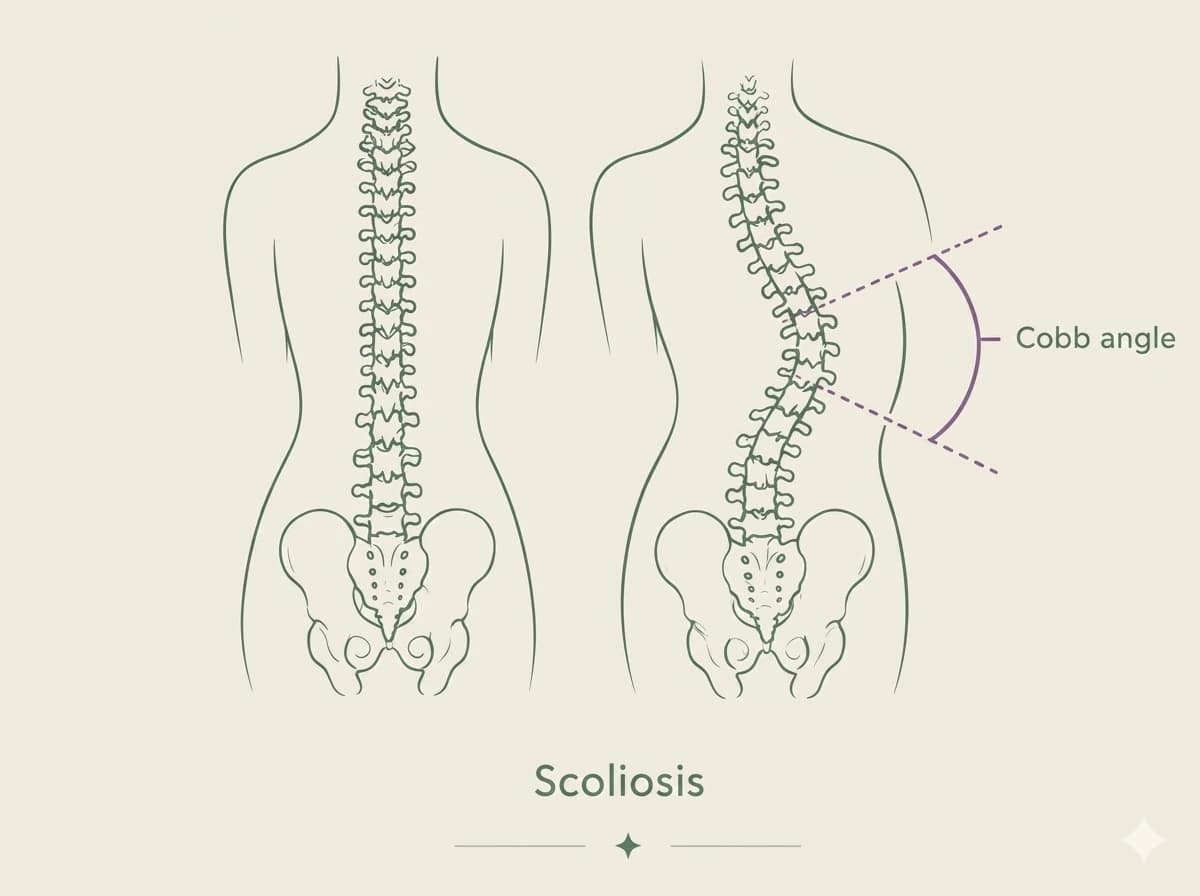
Scoliosis is an abnormal sideways curve of the spine. Viewed from behind, a healthy spine appears essentially straight — scoliosis describes a meaningful departure from that. Doctors measure the severity of the curve using the Cobb angle: the angle between the most tilted vertebrae at the top and bottom of the curve, measured on a standing X-ray. This single, standardized measurement is the foundation for nearly every diagnostic and treatment decision in scoliosis care.
Two Genuinely Different Situations
Adolescent idiopathic scoliosis is the most common form, developing during the growth years for no single known cause — genetics play a real, contributing role, since it runs in families more than chance alone would predict. Curves large enough to be clinically significant (Cobb angle 40° or more) occur in approximately 0.4% of adolescents aged 10-16; much milder curves are considerably more common.
Adult scoliosis is not one condition. It's either a curve that began in adolescence and has persisted (Adult Idiopathic Scoliosis), or a genuinely separate condition — Adult Degenerative ("de novo") Scoliosis — developing for the first time in adulthood from ordinary spinal aging: disc degeneration, facet joint arthritis, and uneven disc height loss gradually pulling the spine out of alignment. This distinction matters clinically, since degenerative scoliosis very commonly coexists with spinal stenosis or spondylolisthesis, and treatment goals shift away from maximal curve correction toward pain relief and preserving function.
Symptoms
Symptoms — What Scoliosis Actually Looks Like
Common signs include uneven shoulders or shoulder blade height, one side of the rib cage appearing more prominent (especially when bending forward), an uneven waistline or hip height, and the body leaning slightly to one side.
Adolescent scoliosis itself is often not painful — an important point, since parents and adolescents sometimes reasonably assume no pain means no problem, when significant curves can exist without any pain at all. Adult scoliosis, particularly degenerative scoliosis, much more commonly does cause real pain alongside these visible signs.
Red Flags — When This Is a Medical Emergency
See a doctor immediately — the same day, not a routine appointment — if you have (or your child has):
Back pain accompanied by fever
New or progressive numbness, tingling, or weakness in the legs
Loss of bladder or bowel control
A rapidly progressing curve or sudden, significant back pain
Scoliosis appearing before age 10, which — unlike the more common adolescent pattern — warrants more thorough evaluation for an underlying cause
Diagnosis
Diagnosis — How Doctors Confirm Scoliosis
Diagnosis begins with a physical examination, including the standard Adam's forward bend test — bending forward at the waist, which makes any rib or waist asymmetry more visible. If scoliosis is suspected, a standing X-ray confirms the diagnosis and allows the Cobb angle measurement.
For adolescents, doctors also assess skeletal maturity (via the Risser sign and, in girls, menstrual history) to estimate how much growth remains — a critical factor in predicting whether a curve is likely to progress. For adults, especially with degenerative scoliosis, additional imaging (MRI) is often needed to assess for coexisting spinal stenosis or nerve involvement, which frequently drives the actual symptoms more than the curve itself.
How Often Does Monitoring Happen?
Typical monitoring intervals are every 4-6 months during active growth, since this is the window where meaningful progression is most likely. Your doctor adjusts this specific interval based on curve size, age, and remaining growth potential — a younger child with more growth ahead generally needs closer, more frequent monitoring than an adolescent nearing skeletal maturity.
Non-Operative Treatment
Curves Under 25° — Observation
Current guidance generally recommends observation alone for smaller curves, with periodic X-rays to monitor for progression rather than active treatment.
Curves of 25-40°, With Growth Remaining — Bracing
Evidence-based bracing is generally recommended once a curve reaches 25-40° in a child with significant growth still ahead. A landmark 2013 randomized trial (BrAIST) found bracing success — defined as avoiding progression to a surgical curve — in more than 70% of adolescents who wore the brace as directed, compared to 48% who didn't. Adherence genuinely matters: the study specifically required at least 18 hours of daily wear for full benefit. Braces are generally not painful when properly fitted, though there's a real adjustment period, and professional fitting matters significantly for both comfort and effectiveness.
Physiotherapeutic Scoliosis-Specific Exercises (PSSE)
Programs such as the Schroth method have real, growing evidentiary support as a conservative option, particularly for milder curves or alongside bracing. These are genuinely distinct from generic core-strengthening exercise, since they're specifically designed around an individual's own curve pattern by a physiotherapist trained in PSSE principles — not a substitute for bracing in curves that meet bracing criteria, or for surgery in curves that meet surgical criteria, but a real, evidence-supported complement.
Exercise
Exercise — What Genuinely Helps
Evidence-informed exercise for scoliosis should generally be guided by a physiotherapist familiar with PSSE principles for anything beyond general conditioning. CARENYX's own reviewed Exercise Library includes generally appropriate supporting options — Thoracic Mobility and Thoracic Rotation for general mobility support, and Bird Dog and Bridge for general core support. See the full Spine Fitness Hub for the complete, curated collection — though for scoliosis specifically, an individualized PSSE program from a qualified physiotherapist, rather than generic exercise alone, is the appropriately evidence-matched approach.
When Surgery Is Required
When Is Surgery Required?
For adolescents, surgery (spinal fusion) is generally considered for curves over 40-45°, or curves continuing to progress despite bracing. For adults, surgery is reserved for those with significant, persistent pain or neurological symptoms not responding to conservative care. Surgical planning for adults is genuinely more complex than adolescent scoliosis surgery, often needing to account for degenerative changes, bone quality, and overall health alongside the curve itself.
Modern spinal fusion for scoliosis, performed by an experienced surgeon, has a real, well-established track record for appropriately selected patients — like any major surgery, it carries real risks your surgeon will discuss specifically with your individual situation.
Recovery
Recovery Timeline
For adolescents treated with bracing, treatment typically continues through the remaining growth period, with brace weaning once skeletal maturity is reached. After spinal fusion surgery (either age group), typical recovery involves several weeks of activity restriction, gradual return to normal activity over 3-6 months, and continued improvement over the following year as the fusion fully consolidates.
For adolescents who complete bracing successfully, most go on to live full, active lives with no meaningful ongoing restriction once skeletal maturity is reached — the treatment goal is specifically to reach adulthood with a curve that won't require surgery later, and successful bracing genuinely achieves this for most adherent patients. Periodic monitoring into early adulthood remains reasonable practice, since a small minority of curves do continue slowly progressing even after growth stops.
Living With Scoliosis Long-Term
For adults living with either idiopathic or degenerative scoliosis, ongoing management centers on staying functionally active, managing pain through the measures above, and monitoring for any new neurological symptoms that might indicate progression or nerve involvement requiring reassessment. Many adults live for decades with a stable, non-progressive curve, requiring nothing beyond periodic check-ins with their spine specialist. For scoliosis surgery specifically, see CARENYX's full Spine Surgery Centre and Recovery Hub, which cover the hospital stay, return-to-activity milestones, and nutrition-during-recovery guidance shared across every spine surgical pathway.
Myths vs. Facts
Myth: Scoliosis is caused by carrying a heavy backpack or bad posture.
Fact: Current evidence does not support this — adolescent idiopathic scoliosis has no single known cause, and genetics play a real, contributing role instead.
Myth: All scoliosis eventually needs surgery.
Fact: The large majority of scoliosis cases — particularly milder curves — are managed with observation alone or bracing, never requiring surgery.
Myth: Adult scoliosis is rare.
Fact: Published estimates suggest adult degenerative scoliosis is genuinely more common than many people realize, and its incidence is higher than adolescent idiopathic scoliosis in some population studies.
Frequently Asked Questions
Save or print this guide
Keep a copy for a doctor's visit, or to share with family.
Related CARENYX Content
References
- 1. Scoliosis Research Society (SRS). Patient and family education on scoliosis.
- 2. American Academy of Orthopaedic Surgeons (AAOS) OrthoInfo. Scoliosis in Children and Adolescents.
- 3. Bracing in Adolescent Idiopathic Scoliosis Trial (BrAIST), 2013, and subsequent SRS/SOSORT bracing guidelines.
- 4. StatPearls (NCBI Bookshelf). Adolescent Idiopathic Scoliosis.
- 5. Adult degenerative scoliosis: challenges in diagnosis, pain management, and surgical decision-making. Frontiers in Surgery.
- 6. CARENYX Knowledge Library. Deformity of Spine (11-deformity-of-spine.md) — real, already-reviewed facts reused directly for platform-wide consistency.